


Food & Beverage Industry Valve Selection Common Mistakes and How to Avoid Them
The food and beverage industry demands far more from valves than general industrial applications—valves must simultaneously meet requirements across four dimensions: hygiene, cleanability, corrosion resistance, and regulatory compliance. Yet in actual engineering practice, common valve selection mistakes are frequent, and the consequences are often severe: product contamination leading to entire batch rejection, failed inspections, audit failures, or even food safety incidents.
Industry practice shows that incorrect valve selection is often the result of multiple overlapping factors—material confusion, incompatible seals, improper connection methods, mismatched pressure ratings, and more. Data indicates that over 60% of early valve failures stem from confusion between 304 and 316L materials, leading to rust and leakage within 3 months, or even production stoppages in severe cases.
This guide compiles common valve selection mistakes in the food and beverage industry and provides systematic methods to avoid them.
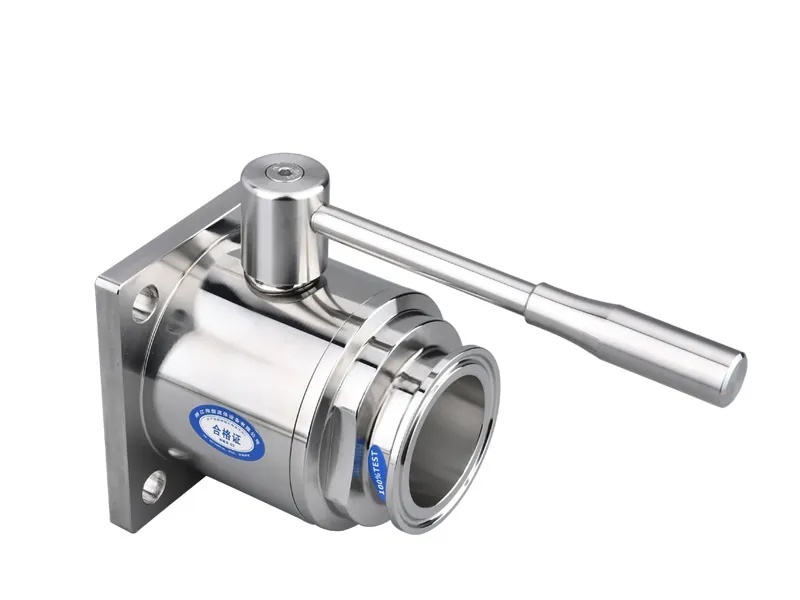
1. Material Selection Errors
1.1 Error: Substituting 304 for 316L
Typical manifestation: Believing that 304 and 316L are "about the same" and choosing 304 to save cost.
Consequence: In chlorine-containing CIP environments (sodium hypochlorite cleaners) or acidic beverages (juice, carbonated drinks), the chromium oxide passive film on 304 is easily destroyed by chloride ions or organic acids. Pitting corrosion occurs within 2 years, and metal ion leaching can cause heavy metal exceedance in products.
Correct practice: Valves contacting acidic beverages or chlorine-containing CIP must use 316L stainless steel. Its molybdenum (Mo) content significantly improves pitting resistance.
Verification method: Request spectrometer test reports from suppliers to confirm material grade.
1.2 Error: Ignoring Surface Finish Requirements
Typical manifestation: Using standard industrial valves without polished internal surfaces or with insufficient roughness.
Consequence: Rough internal surfaces (excessive Ra value) create microbial attachment points; CIP cleaning is incomplete, leading to total bacterial count exceedance and batch rejection.
Correct practice: Food contact valve internal surfaces must undergo mechanical polishing (Ra ≤ 0.8μm) ; aseptic grade requires electropolishing (EP, Ra ≤ 0.4μm) .
1.3 Error: Valves Without Degreasing
Typical manifestation: Using standard valves containing industrial lubricating oil.
Consequence: Oil contamination of product, leading to failed inspections and entire batch rejection.
Correct practice: Food-grade valves must be degreased and use NSF H1 food-grade lubricants.
2. Seal Selection Errors
2.1 Error: Seal Material Incompatible with Media
Key principle of seal selection: Seal materials must be compatible with both process media AND CIP cleaners. Incorrect selection often results in seal failure within weeks to months.
Typical error case: A food plant used 304 valves with ordinary nitrile rubber seals for high-temperature media delivery. Leakage occurred within 1 month due to seal aging.
Correct selection reference:
| Seal Material | Suitable Media | Unsuitable Media | CIP Compatibility |
|---|---|---|---|
| EPDM | Water, alkalis, steam | Oils, hydrocarbons, citrus oils | ✅ Excellent |
| PTFE | Strong acids, organic solvents | Strong alkalis at high temperature (creep) | ✅ Excellent |
| FKM (Viton) | Oils, high temperature | Steam (accelerates aging) | ⚠️ Limited |
| Silicone | Food contact, high purity | Steam, oils | ❌ Not steam-resistant |
Special case: In PFA plug valves used in the food industry, improper seal selection can cause the plug to rotate with difficulty or seize due to solidification of high-sugar or high-protein media.
2.2 Error: Not Using Food-Grade Seals
Consequence: Non-food-grade seals leach impurities; products fail inspection; cannot pass food safety certification.
Correct practice: Food contact seals must comply with FDA 21 CFR requirements—choose FDA-certified EPDM, silicone, or PTFE.
3. Connection Method Errors
3.1 Error: Using Threaded Connections in Sanitary Applications
Consequence: Thread crevices become microbial harbourage points; cannot be thoroughly cleaned by CIP.
Correct practice: Product contact lines should use Tri-Clamp quick-connect or welded connections for easy disassembly, cleaning, and sterilisation—eliminating dead legs.
3.2 Error: Incorrect Clamp Installation
Typical manifestation: Clamps under-tightened or over-tightened.
Consequence: Under-tightening causes leakage or crevices; over-tightening damages flanges and gaskets.
Correct practice: Use torque wrench for even tightening; avoid over-tightening one side; verify gasket fully seated after installation.
4. Pressure Rating and Sizing Errors
4.1 Error: Pressure Rating Mismatch
Typical manifestation: Pipe design pressure PN25 but PN16 valve selected, or vice versa.
Consequence: Pressure rating too low → disc deformation or bursting under long-term operation; pressure rating too high → unnecessary cost, incorrect installation dimensions.
Correct practice: Valve pressure rating must be ≥ pipe design pressure, and nominal diameter (DN) must match exactly.
4.2 Error: Sizing Steam Control Valves by Pipe Size
Typical manifestation: Steam control valve selected with same size as pipeline.
Consequence: Steam control valves typically should be smaller than the pipeline. Oversizing causes the valve to operate near the closed position, resulting in unstable temperature control and oscillation.
Correct practice: Calculate required Cv value based on steam flow, pressure, and heating time. Steam valves are typically one to two sizes smaller than the pipeline.
5. Selection Process and Methodology Errors
5.1 Error: Selecting Valve Type Before Defining Process Requirements
Typical manifestation: Determining valve type before clarifying process control requirements, then "forcing" it into the process.
Consequence: A common control failure scenario—production requires continuous flow regulation (proportional control), but a valve designed only for on/off service is incorrectly selected. The valve cannot maintain stable mid-stroke position, causing flow oscillation and product quality fluctuation.
Correct practice: Define control requirements first (continuous regulation or on/off control? Required rangeability? Minimum/normal/maximum flow?), then select valve type.
5.2 Error: Ignoring Valve Response Speed and Accuracy Requirements
Typical manifestation: Using large-diameter butterfly or ball valves in processes requiring precise temperature control (±0.5-1°C accuracy).
Consequence: Butterfly and ball valves, while offering high rangeability and flow, have narrow control ranges and limited accuracy. In applications like dairy pasteurisation and bioreactor temperature control, even a 1°C temperature deviation can affect product quality.
Correct practice:
| Control Accuracy Requirement | Recommended Valve Type |
|---|---|
| ±0.5-1°C (precise control) | Globe/control valve |
| ±5°C (general control) | Ball or butterfly valve |
| Aseptic/hygienic isolation | Diaphragm valve |
Case study: A plant corrected temperature controller tuning and valve configuration issues, and the steam savings recovered the project investment within 3 months.
6. Common Selection Error Quick Checklist
| Category | Typical Error | Correct Practice |
|---|---|---|
| Material | 304 substituted for 316L | Mandatory use 316L for acidic/chlorine-containing CIP environments |
| Surface treatment | Internal surfaces not polished | Specify Ra ≤ 0.8μm; require test reports |
| Seals | Standard industrial seals | FDA-certified food-grade seals |
| Seals | Seal material incompatible | Select based on media and CIP chemicals |
| Connection | Threaded connections | Use Tri-Clamp or welded |
| Pressure rating | PN mismatch | Valve PN ≥ pipe design pressure |
| Valve type | Select valve before defining process | Define control requirements first, then select valve |
| Steam control | Size steam valve by pipe size | Calculate by Cv; typically choose 1-2 sizes smaller |
| Lubrication | Industrial lubricants | NSF H1 food-grade lubricant + degreasing |
| Certification | Ignoring FDA/3-A | Confirm material certificates, polish reports, certification documents |


