


Sanitary Pipe Connection Methods Comparison: Tri‑clamp / Welded / Threaded / Flanged
In the food, dairy, beverage, pharmaceutical, biotech and water treatment industries, the connection method of piping systems directly affects hygienic performance, installation cost, maintainability and long‑term reliability. The four most common connection methods – tri‑clamp, welded, threaded and flanged – each have unique advantages and limitations.
Choosing the wrong connection method can lead to cleaning dead legs, leak risks, microbial growth, product contamination and even batch failures. This guide provides a comprehensive comparison of these four methods across structural principles, hygienic performance, installation, maintenance, cost and application scenarios, helping engineers make informed decisions.
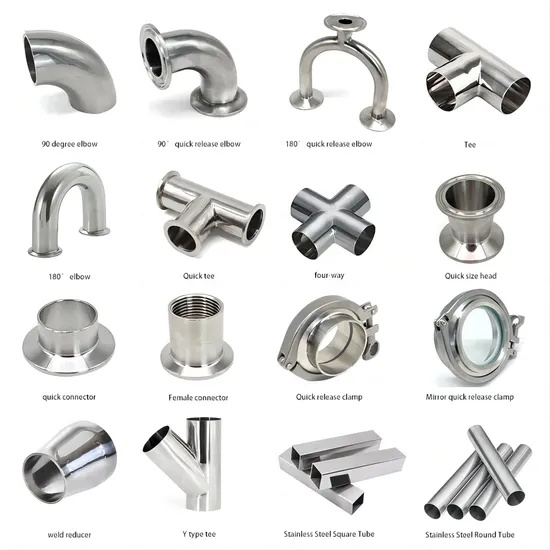
1. Overview of Four Connection Methods
| Connection Method | Principle | Typical Applications | Hygienic Rating | Cost |
|---|---|---|---|---|
| Tri‑clamp | Two ferrules + gasket + outer clamp | Food, beverage, pharma, biotech | ⭐⭐⭐⭐⭐ Highest | Medium |
| Welded | Butt weld fusion (TIG/orbital) | Pharma, aseptic, permanent installations | ⭐⭐⭐⭐⭐ Highest (no seals) | High |
| Threaded | Male + female threads with sealant/tape | Low‑pressure water, compressed air, non‑sanitary | ⭐⭐ Low | Low |
| Flanged | Two flanges + gasket + bolts | Large bore, high pressure, chemical | ⭐⭐⭐ Medium | Medium |
2. Tri‑clamp Connection (Sanitary Clamp)
2.1 Structural Principle
A tri‑clamp connection consists of three parts:
Two ferrules (with flared or flat ends)
Gasket (EPDM, PTFE, silicone, etc.)
Outer clamp (single‑piece or two‑piece with tightening nut)
When installed, the gasket is placed between the two ferrule faces, the clamp is fitted around them, and the nut is tightened. The clamp’s tapered or flat surfaces compress the gasket to create a seal.
2.2 Advantages
| Advantage | Description |
|---|---|
| Easy assembly/disassembly | No special tools, quick to remove and reinstall |
| High hygienic performance | Smooth internal bore, no threaded dead legs, gasket aligns with pipe ID |
| Easy to clean | Can be cleaned in place (CIP) or disassembled for COP |
| Highly standardised | ISO 2852, ASME BPE, DIN 32676 standards |
| Wide size range | DN10–DN300, common in food and pharma |
2.3 Disadvantages
| Disadvantage | Description |
|---|---|
| Higher cost than threaded | Ferrules and clamps are more expensive |
| Gasket requires periodic replacement | Gasket is a consumable (1-3 years) |
| Potential leakage at high pressure | Typically ≤16 bar; higher pressures require special design |
| Space requirement | Clamp occupies additional space; needs consideration in dense layouts |
2.4 Applications
Food, beverage, dairy production lines
Pharmaceutical and biotech (especially where frequent disassembly for cleaning is needed)
CIP supply and return lines
Lines requiring regular inspection and cleaning
Modular and portable equipment
✅ Typical locations where tri‑clamp is recommended:
Pump suction/discharge
Valve connections (both ends)
Instrument connections (pressure gauges, temperature sensors)
Hose connections
Pipe sections requiring periodic disassembly for cleaning
3. Welded Connection
3.1 Structural Principle
Welded connection joins two pipe ends by fusing the metal together using TIG (GTAW) or orbital automatic welding. Sanitary welding requires back‑purging with argon to prevent internal surface oxidation.
3.2 Advantages
| Advantage | Description |
|---|---|
| No seals | No gasket aging or leak risk |
| Highest hygienic performance | Smooth internal bore, no crevices, no gaps |
| Permanent connection | No maintenance, life equal to pipe |
| High pressure and temperature capability | Withstands full system ratings |
| Suitable for SIP | No seals, withstands steam sterilisation |
3.3 Disadvantages
| Disadvantage | Description |
|---|---|
| Non‑removable | Cannot be disassembled for cleaning or replacement |
| High installation cost | Requires skilled welders and welding equipment |
| Quality depends on welder skill | Weld defects (porosity, lack of penetration) create hygienic dead legs and leaks |
| Welding distortion | Thin‑wall pipes may distort |
| Internal oxidation | Without argon purge, internal surface forms scale (temper colour) |
3.4 Applications
Pharmaceutical aseptic processes (WFI, pure steam, bioreactors)
High‑purity water systems
Permanently installed piping
Processes where seals are not allowed
Lines requiring SIP sterilisation
⚠ Welding quality requirements:
Internal weld reinforcement ≤ 10% of wall thickness
Internal surface colour should be silver‑white or light yellow (no blue/black oxidation)
100% of welds require borescope inspection
Optional: radiographic testing (RT) or dye penetrant testing (PT)
4. Threaded Connection
4.1 Structural Principle
Threaded connection joins a male threaded fitting to a female threaded fitting or valve. The seal is achieved by thread interference and sealing material (PTFE tape or pipe sealant).
4.2 Advantages
| Advantage | Description |
|---|---|
| Lowest cost | Fittings and machining are inexpensive |
| Simple installation | No special tools – standard wrenches |
| Removable | Can be disassembled repeatedly |
| Standardised | NPT, BSPP, BSPT international standards |
4.3 Disadvantages
| Disadvantage | Description |
|---|---|
| Poor hygienic performance | Thread crevices are ideal for microbial growth |
| Difficult to clean | Cannot be CIP cleaned – must be disassembled for COP |
| Leak risk | Sealant ages, vibration loosens threads |
| Not suitable for SIP | Seal materials do not withstand steam |
| Not suitable for high viscosity | Thread crevices trap particles |
4.4 Applications
Threaded connections are severely restricted in sanitary systems. They may be considered only in:
Compressed air lines (non‑product contact)
Instrument air supply lines
Drain lines
Low‑pressure cooling water (closed loop)
Temporary test lines
❌ Not recommended for product‑contact lines. If unavoidable, use sanitary threads (e.g., RJT, DIN 11851) and disassemble for COP cleaning regularly.
5. Flanged Connection
5.1 Structural Principle
A flanged connection consists of two flanges, a gasket, and a set of bolts and nuts. The seal is achieved by compressing the gasket between the flange faces using bolt preload.
5.2 Advantages
| Advantage | Description |
|---|---|
| Easy assembly/disassembly | Bolts are accessible |
| Suitable for large bore | DN50 and above, up to DN600+ |
| High pressure capability | Up to 100 bar or more |
| Flexible gasket selection | PTFE, EPDM, spiral wound, etc. depending on media |
5.3 Disadvantages
| Disadvantage | Description |
|---|---|
| Medium hygienic performance | Step (bore mismatch) unless weld neck flanges are used |
| Large and heavy | Takes space, heavy weight |
| Many bolts | Time‑consuming to install |
| Gasket requires periodic replacement | Gasket ages and leaks |
| Higher cost than tri‑clamp for small sizes | Large flanges are expensive |
5.4 Applications
Large‑bore piping (≥DN100)
High‑pressure systems (>16 bar)
Chemical media transfer
Equipment connections (tanks, pumps, heat exchangers)
Large‑bore connections requiring occasional disassembly
Special requirements for sanitary flanges:
Use weld neck (WN) flanges with bore matching pipe ID to eliminate step
Sealing face should be male‑female or tongue‑and‑groove for better sealing
Gaskets must be FDA‑compliant materials
6. Comprehensive Comparison Table
| Comparison Aspect | Tri‑clamp | Welded | Threaded | Flanged |
|---|---|---|---|---|
| Hygienic performance | ⭐⭐⭐⭐⭐ | ⭐⭐⭐⭐⭐ | ⭐⭐ | ⭐⭐⭐ |
| Removability | Excellent (fast) | None | Good (removable) | Excellent (slow) |
| Installation difficulty | Low | High (skilled welder) | Low | Medium |
| Initial cost | Medium | High | Low | Medium‑High (depends on size) |
| Maintenance cost | Low (gasket change) | Very low | Medium (sealant aging) | Medium (gasket change) |
| Pressure rating | ≤16 bar | Full system | ≤10 bar | ≤100 bar |
| Temperature range | -20~150°C (gasket dependent) | -50~200°C | -20~120°C | -50~200°C |
| CIP suitability | ✅ Excellent | ✅ Excellent | ❌ COP only | ⚠ Medium (needs dead‑leg‑free design) |
| SIP suitability | ⚠ Gasket dependent (PTFE OK) | ✅ Excellent | ❌ Not suitable | ⚠ Gasket dependent |
| Typical size range | DN10–DN300 | DN6–DN600 | DN6–DN100 | DN25–DN600 |
| Standards | ISO 2852, ASME BPE, DIN 32676 | ASME BPE, DIN, ISO | NPT, BSPP, BSPT | ASME B16.5, EN 1092 |
7. Selection Decision Guide
7.1 Decision Flowchart
┌─────────────────────────────────────────────────────────────┐
│              Step 1: Does the line contact product?          │
└─────────────────────────────────────────────────────────────┘
                    │                    │
                    No                   Yes
                    ▼                    ▼
           ┌──────────────┐      ┌─────────────────────────────┐
           │ Non‑product   │      │      Product contact        │
           │ (air, drain)  │      └─────────────────────────────┘
           └──────────────┘                 │
                    │                        ▼
                    ▼              ┌─────────────────────────────┐
           ┌──────────────┐        │  Does it need frequent      │
           │ Thread or    │        │  disassembly for cleaning?  │
           │ tri‑clamp    │        └─────────────────────────────┘
           └──────────────┘                 │                    │
                                             Yes                 No
                                             ▼                    ▼
                                ┌─────────────────┐      ┌─────────────┐
                                │   Tri‑clamp      │      │  Is SIP     │
                                │ (removable)      │      │  required?  │
                                └─────────────────┘      └─────────────┘
                                                                  │
                                                                  ▼
                                                        ┌─────────────────┐
                                                        │  Yes          No │
                                                        ▼                ▼
                                                ┌───────────┐      ┌───────────┐
                                                │  Welded    │      │ Tri‑clamp │
                                                │(permanent) │      │(preferred)│
                                                └───────────┘      └───────────┘
7.2 Application‑Specific Recommendations
| Application | Recommended Connection | Reason |
|---|---|---|
| Food/beverage lines (general) | Tri‑clamp | Removable for cleaning, moderate cost |
| Dairy lines (frequent CIP) | Tri‑clamp or welded | Tri‑clamp for maintainability, welded for permanence |
| Pharmaceutical WFI circulation | Welded | No seals, SIP capable, highest hygiene |
| Aseptic filling lines | Welded + tri‑clamp (valves) | Main lines welded, valves tri‑clamp for replacement |
| Bioreactors | Welded | Absolute sterility required |
| CIP supply main | Tri‑clamp | Easy cleaning and modification |
| Compressed air (non‑product) | Threaded or tri‑clamp | Threaded for low cost, tri‑clamp for higher hygiene |
| Large tank connections (DN100+) | Flanged or tri‑clamp | Flanged for pressure, tri‑clamp for hygiene |
| High‑pressure systems (>16 bar) | Flanged or welded | Pressure capability |
| Temporary/test lines | Tri‑clamp | Quick assembly/disassembly, flexible |
8. Common Problems & Solutions
| Problem | Possible Cause | Solution |
|---|---|---|
| Tri‑clamp leak | Worn gasket, under‑torqued clamp, damaged ferrule face | Replace gasket, torque to spec, replace ferrule |
| Welded internal oxidation | No argon back‑purging | Grind and reweld with proper purge |
| Weld internal drop‑through (sugaring) | Incorrect welding parameters | Reweld with optimised parameters |
| Threaded connection leak | Insufficient tape, damaged threads | Reapply tape, replace fitting |
| Flanged connection leak | Worn gasket, uneven bolt tightening | Replace gasket, tighten bolts in star pattern |
| Tri‑clamp gasket extrusion | Wrong gasket size, over‑torquing | Use correct gasket size, use torque wrench |
9. Why Choose Engineering Plumbing for Your Pipe Connection Solutions?
At Engineering Plumbing, we provide comprehensive connection products and solutions for sanitary piping systems:
Tri‑clamp connections: ISO 2852 / ASME BPE ferrules, gaskets (EPDM/PTFE/silicone), outer clamps (single/two‑piece)
Welded connections: Butt‑weld fittings, orbital welding services, weld borescope inspection, argon purge
Threaded connections: Sanitary threads (RJT/DIN 11851) only on request, with COP cleaning recommendation
Flanged connections: Weld neck flanges, lap joint flanges, FDA‑certified gaskets
Accessories: Blind flanges, reducers, hose adapters, sampling valve connections
Quality assurance: MTRs, surface finish reports (optional) for all products
📞 Pipe Connection Technical Consultation
Send your system parameters (media type, temperature, pressure, bore size, cleaning requirements) to our engineering team. We will reply with connection method recommendations and product list within 48 hours.
Frequently Asked Questions (FAQ)
1. Why are threaded connections not recommended in sanitary systems?
Threaded connections have thread crevices that cannot be effectively flushed by CIP cleaning fluids. Microorganisms easily colonise these crevices and form biofilms. Therefore, hygienic standards such as 3‑A and EHEDG do not recommend threaded connections in product‑contact lines.
2. How often should tri‑clamp gaskets be replaced?
EPDM: 1-2 years (depending on CIP frequency and temperature)
PTFE: 2-3 years
Silicone: 1-2 years
Recommendation: Inspect gasket each time it is disassembled; replace if hardened, cracked or permanently deformed.
3. Is a welded connection absolutely dead‑leg‑free?
A high‑quality weld (smooth internal surface, no oxidation) can achieve theoretically zero dead leg. However, the microscopic roughness of the weld reinforcement remains a potential risk. ASME BPE requires weld reinforcement ≤10% of wall thickness and internal surface finish Ra ≤0.4 μm.
4. Can tri‑clamp connections be used for SIP?
Yes, but steam‑resistant gasket materials must be used. PTFE or PTFE/EPDM composite gaskets are recommended (up to 150°C steam). Standard EPDM has a short life under SIP conditions.
5. How can flanged connections be made more hygienic?
Use weld neck (WN) flanges with bore matching pipe ID
Choose male‑female or tongue‑and‑groove sealing faces
Ensure gasket ID matches pipe ID (no protrusion)
Bolt holes should not contact the product
6. Can different connection methods be mixed in one system?
Yes. For example: main lines welded, valves connected with tri‑clamp; large equipment ports flanged, small lines tri‑clamp. The key is to ensure that the transition does not reduce hygienic performance.
7. What is the cost difference between tri‑clamp and welded for a DN50 pipe section?
For a DN50 joint:
Tri‑clamp: two ferrules + gasket + clamp ≈ $30–50
Welded: welder labour (0.5-1 hour) + equipment depreciation + argon ≈ $50–100 per weld
Welded has higher initial cost but no ongoing maintenance. Tri‑clamp allows easy replacement but requires periodic gasket changes.
8. Do you offer orbital welding services?
Yes. We provide on‑site orbital automatic welding for stainless steel sanitary piping. Orbital welding ensures consistent welding parameters, reduces human error, and produces weld quality superior to manual welding.


