Centrifugal Pump vs. Rotary Lobe Pump vs. Diaphragm Pump – Working Principles & Comparison
In the food, pharmaceutical, biotech and water treatment industries, sanitary pumps are the core equipment for fluid transfer. Centrifugal pumps, rotary lobe pumps and diaphragm pumps are the three most common types of sanitary pumps. Their working principles, application scenarios and performance characteristics differ significantly. Choosing the right pump type directly affects product quality, system efficiency and operating costs.
1. Centrifugal Pump
1.1 Working Principle
The centrifugal pump belongs to the kinetic pump (dynamic pump) category. Its core working principle is based on centrifugal force.
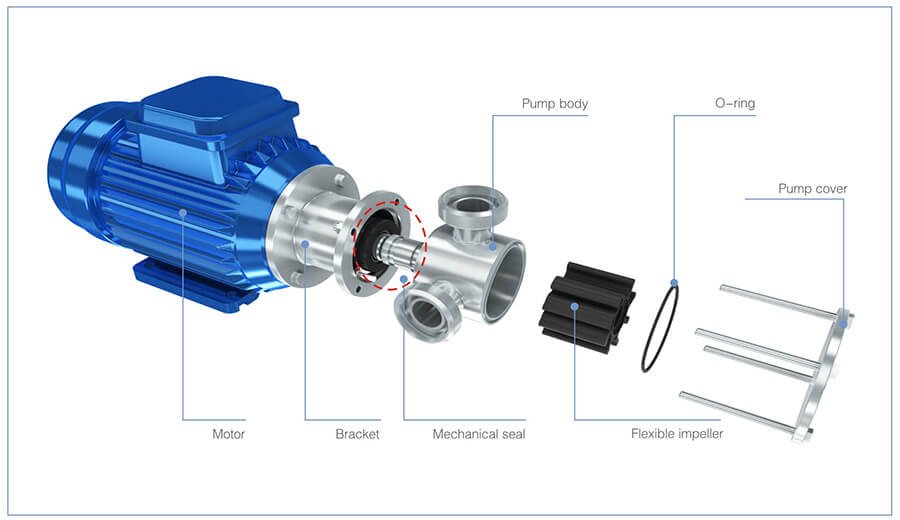
After the pump casing is filled with liquid, the motor drives the impeller to rotate at high speed. The liquid is thrown from the centre of the impeller to the outer edge by centrifugal force. The liquid enters the volute casing at high velocity, where the velocity gradually decreases and kinetic energy is converted into pressure energy, finally being discharged through the outlet. At the same time, a low‑pressure zone forms at the impeller centre, creating a pressure difference with the suction liquid level, causing liquid to be continuously “drawn in” and discharged.
1.2 Key Characteristics
Characteristic Description Working principle Dynamic energy conversion (kinetic → pressure) Flow characteristic Flow varies with system resistance; not precisely controllable Speed High speed (typically 1450–2900 rpm) Self‑priming None – must be filled with liquid before start‑up Shear High – high‑speed impeller applies shear to fluid Viscosity suitability Suitable for low‑viscosity liquids (< 500 SSU) Typical efficiency 60–70% (at best efficiency point) 1.3 Applications of Sanitary Centrifugal Pumps
Sanitary centrifugal pumps differ from standard centrifugal pumps in that their design and manufacturing follow international hygienic standards. Wetted parts are made of stainless steel with polished surfaces, meeting the strict hygiene requirements of food, pharmaceutical and cosmetic industries.
Typical applications:
Low‑viscosity liquids such as milk, beverages, wine
CIP cleaning solution supply and return
Systems with high resistance (e.g., tubular sterilisation, yogurt holding)
Water, raw milk, beverage products, cleaning solutions
1.4 Advantages & Limitations
Advantages Limitations Simple structure, low cost No self‑priming capability High flow rate, high efficiency Not suitable for high‑viscosity media Smooth operation, no pulsation High shear may damage sensitive product components Easy to operate and maintain Flow cannot be precisely controlled 2. Rotary Lobe Pump
2.1 Working Principle
The rotary lobe pump belongs to the positive displacement pump category. Its core structure consists of two synchronised counter‑rotating lobe rotors (typically bi‑lobe or tri‑lobe) mounted in a precision‑machined pump casing.
The rotor rotation is driven by an external timing gearbox, ensuring the two rotors maintain precise phase relationship and do not contact each other. As the rotors rotate, the volume at the inlet increases, creating negative pressure that draws liquid into the pump chamber. The liquid is conveyed between the rotors and the casing. As the volume between the rotors decreases, liquid is forced out through the discharge port. Each rotation cycle delivers a fixed volume.
2.2 Key Characteristics
Characteristic Description Working principle Positive displacement Flow characteristic Proportional to rotational speed; precisely controllable Speed Low speed (typically 200–600 rpm) Self‑priming Good self‑priming capability Shear Very low – non‑contacting rotors provide gentle handling Viscosity suitability Suitable for low to high viscosity media Typical efficiency 90–99% 2.3 Applications of Sanitary Rotary Lobe Pumps
Sanitary rotary lobe pumps feature stainless steel wetted parts with mirror‑polished surfaces, combining hygiene with corrosion resistance. Their non‑contacting rotor design allows gentle fluid handling without damaging product texture, structure or quality.
Typical applications:
High‑viscosity media (syrup, cream, yoghurt, etc.)
Particle‑containing media (fruit pieces, active microorganisms)
Fibre‑containing media
Viscous and low‑viscosity media in cosmetics and pharmaceutical industries
Shear‑sensitive biological products (fermentation broth, cell culture media)
2.4 Advantages & Limitations
Advantages Limitations Handles high‑viscosity and particle‑containing media Higher cost than centrifugal pumps Low shear, preserves product integrity More complex structure Precisely controllable flow Requires regular rotor clearance inspection Self‑priming capability Lower speed, relatively lower flow rate Can run dry (short periods) Pulsating discharge (requires dampener) 3. Diaphragm Pump
3.1 Working Principle
The diaphragm pump belongs to the reciprocating positive displacement pump category. Its core feature is the use of a flexible diaphragm reciprocating motion to change pump chamber volume, achieving liquid suction and discharge.
In a pneumatically driven double‑diaphragm pump: compressed air alternately drives two diaphragms through an air valve. When one diaphragm expands outward, the pump chamber volume increases, creating low pressure that draws liquid in; the other diaphragm contracts inward, reducing pump chamber volume and forcing liquid out. The two diaphragms are connected by a centre shaft and work alternately for continuous delivery.
Key design feature: the diaphragm completely isolates the compressed air (or mechanical drive components) from the pumped media. The fluid only contacts the pump chamber and the diaphragm – it does not touch any moving parts.
3.2 Key Characteristics
Characteristic Description Working principle Positive displacement (reciprocating) Drive type Pneumatic or electric Self‑priming Good – can self‑prime and run dry Shear Very low – fluid does not contact moving parts Seal design No shaft seal – completely eliminates leak risk Pulsation Present (double‑diaphragm design reduces it) 3.3 Applications of Sanitary Diaphragm Pumps
Sanitary diaphragm pumps have unique advantages in food and pharmaceutical industries. Their shaft‑less seal design eliminates the risk of leakage associated with traditional pump shaft seals. In hygienic applications, the one‑piece diaphragm design eliminates residue traps between the outer plate and diaphragm, improving cleanability and extending diaphragm life.
Typical applications:
Corrosive, high‑viscosity, particle‑containing or flammable/explosive liquids
Sensitive fluids requiring sterile transfer
Shear‑sensitive products (live cells, protein solutions)
Low‑flow, high‑head metering delivery
3.4 Advantages & Limitations
Advantages Limitations No shaft seal, zero leak risk Pulsating discharge Can run dry, good self‑priming Relatively low flow rate Very low shear, preserves product integrity Diaphragm is a consumable – requires regular replacement Handles particle‑containing and high‑viscosity media Pneumatic diaphragm pumps require compressed air supply Easy to clean, CIP/SIP compatible Relatively low efficiency 4. Comprehensive Comparison Table
Comparison Aspect Centrifugal Pump Rotary Lobe Pump Diaphragm Pump Pump type Kinetic (dynamic) Positive displacement (rotary) Positive displacement (reciprocating) Working principle Centrifugal force Rotor volume change Diaphragm reciprocation Flow characteristic Varies with resistance Proportional to speed Proportional to stroke/frequency Self‑priming ❌ No ✅ Yes ✅ Strong Shear High Very low Very low Viscosity suitability Low viscosity (<500 SSU) Low→High viscosity Low→High viscosity Particle handling Limited Good Good Seal risk Shaft seal – leak risk Shaft seal – leak risk No shaft seal – zero leak Pulsation None Present (slight) Present Typical efficiency 60–70% 90–99% Medium Relative cost Low Medium‑High Medium (pneumatic) / High (electric) Typical applications Water, milk, CIP fluids Yoghurt, syrup, fermentation broth Sensitive fluids, sterile transfer 5. Selection Decision Guide
5.1 Quick Selection Flowchart
                     Step 1: What are the media characteristics?
                                    │
                    ┌───────────────┼───────────────┐
                    │               │               │
               Low viscosity   High viscosity/     Shear-sensitive/
                               particles          sterile
                    │               │               │
                    ▼               ▼               ▼
              Centrifugal      Rotary Lobe      Diaphragm
                Pump             Pump             Pump
            (First choice)   (First choice)   (First choice)
5.2 Selection Recommendations Summary
Operating Condition Recommended Pump Type Reason Low‑viscosity liquids (water, milk, thin juice) Centrifugal pump High efficiency, low cost, high flow High‑viscosity media (syrup, cream, yoghurt) Rotary lobe pump Low shear, precisely controllable flow Particle‑containing media (fruit pieces, active microorganisms) Rotary lobe pump Gentle handling, preserves product integrity Sterile transfer, high cleanliness requirements Diaphragm pump No shaft seal, zero leakage Corrosive, flammable/explosive liquids Diaphragm pump (pneumatic) No electrical components, safe CIP supply, high‑flow circulation Centrifugal pump High flow, high efficiency Low flow, high head, metering Diaphragm pump Precise metering 5.3 Key Selection Principles
“For low‑viscosity liquids, choose centrifugal pumps first. For high‑viscosity or particle‑containing media, rely on rotary lobe pumps to ensure gentle handling.”
Start with media characteristics: viscosity, solids content and shear sensitivity are the primary selection criteria
Then consider process requirements: flow rate, head, CIP/SIP compatibility, sterility requirements
Finally consider cost: initial investment, operating cost, maintenance cost
Materials and surface finish: wetted parts should be SS304/SS316L, surface polished to Ra ≤ 0.8 μm (Ra ≤ 0.4 μm for aseptic applications)
6. Why Choose Engineering Plumbing for Sanitary Pump Solutions?
At Engineering Plumbing, we provide complete sanitary pump solutions for food, pharma and biotech industries:
Centrifugal pumps: Stainless steel sanitary centrifugal pumps – ideal for high‑flow, low‑viscosity liquid transfer, CIP compatible
Rotary lobe pumps: Sanitary lobe rotor pumps – low‑shear handling of high‑viscosity and particle‑containing media
Diaphragm pumps: Pneumatic/electric sanitary diaphragm pumps – shaft‑less seal design, suitable for aseptic and sensitive fluid transfer
Support services: Pump sizing calculations, pipe matching, CIP velocity verification, installation and commissioning
📞 Pump Selection Consultation
Send your media parameters (type, viscosity, temperature, solids content), flow rate requirements and hygienic classification to our engineering team. We will return a complete pump selection proposal within 48 hours.Frequently Asked Questions (FAQ)
1. What is the main difference between a centrifugal pump and a positive displacement pump?
A centrifugal pump is a dynamic pump – its flow rate varies with system resistance. A positive displacement pump (rotary lobe or diaphragm) delivers a fixed volume per rotation/cycle, making it less sensitive to system resistance.
2. Which pump type is best for shear‑sensitive products?
Rotary lobe pumps and diaphragm pumps are both excellent for shear‑sensitive products. Rotary lobe pumps use non‑contacting rotors; diaphragm pumps have no moving parts in contact with the fluid. Both handle fluids gently.
3. Why are sanitary pumps more expensive than standard pumps?
Sanitary pumps have higher material costs (stainless steel), stricter surface finish requirements, FDA/USP compliant seals, and must meet hygienic design standards (3‑A, EHEDG). These factors increase manufacturing costs.
4. Can centrifugal pumps handle CIP cleaning?
Yes. Sanitary centrifugal pumps are suitable for CIP applications. However, they must be designed with hygienic seals and polished internal surfaces to ensure complete cleanability.
5. How often do diaphragm pump diaphragms need to be replaced?
Typically 1-2 years depending on the media, operating temperature and frequency of use. For aggressive or high‑temperature media, replacement may be more frequent. Regular inspection is recommended.
6. Which pump type is most energy‑efficient?
Centrifugal pumps generally have the highest efficiency (60–70% at BEP) for low‑viscosity liquids. Rotary lobe pumps have high volumetric efficiency (90–99%) but operate at lower speeds. Efficiency depends on the specific application.
7. Can rotary lobe pumps handle abrasive media?
Rotary lobe pumps have a clearance gap between the rotors and casing. Highly abrasive media can accelerate wear and increase clearances, reducing efficiency. For abrasive media, hardened rotors or reduced clearances may be required.
8. How do I prevent pump pulsation?
For rotary lobe pumps, install a pulsation dampener (bladder‑type or in‑line) on the discharge side. For diaphragm pumps, the double‑diaphragm design naturally reduces pulsation, but a dampener is still recommended for sensitive applications.
9. What is NPSH and why is it important for centrifugal pumps?
NPSH (Net Positive Suction Head) is the pressure required at the pump suction to prevent cavitation. Insufficient NPSH causes cavitation – bubbles form and collapse, damaging the impeller. It is a critical design parameter for centrifugal pumps.
10. Can diaphragm pumps be used for SIP (steam‑in‑place)?
Yes. Sanitary diaphragm pumps with PTFE diaphragms can withstand SIP temperatures (up to 150°C). However, SIP cycles reduce diaphragm life – consider this in maintenance planning.