


Dairy Industry Sanitary Valve Special Requirements and Selection Guide
The dairy industry imposes the most stringent valve requirements of any food and beverage category. Unlike fruit juice or bottled water, dairy products—particularly liquid milk—are highly perishable, nutrient-rich, protein-heavy media, and also serve as ideal growth media for pathogens such as Salmonella and Listeria. Any minor cleaning dead leg or seal failure can result in microbiological contamination of an entire batch within hours.
This guide focuses on the special requirements for sanitary valves in the dairy industry (liquid milk, yoghurt, milk powder, ice cream, etc.). From the four dimensions of regulatory constraints, media characteristics, cleaning validation, and material selection, it helps engineering and technical personnel understand the key differences in dairy applications beyond general beverage selection.
1. Regulatory and Standards Constraints in the Dairy Industry
One of the core differences between the dairy industry and other beverage categories is the regulation-driven mandatory requirements. In the United States, dairy contact equipment must comply with the FDA Pasteurized Milk Ordinance (PMO) . The PMO has specific requirements for valve hygienic design, with one key restriction:
Butterfly valve applications in the dairy industry are restricted by the PMO, as their construction does not meet FDA requirements for dairy contact equipment. This is not a technical limitation of butterfly valves themselves, but a specific regulation established by the FDA for dairy product safety.
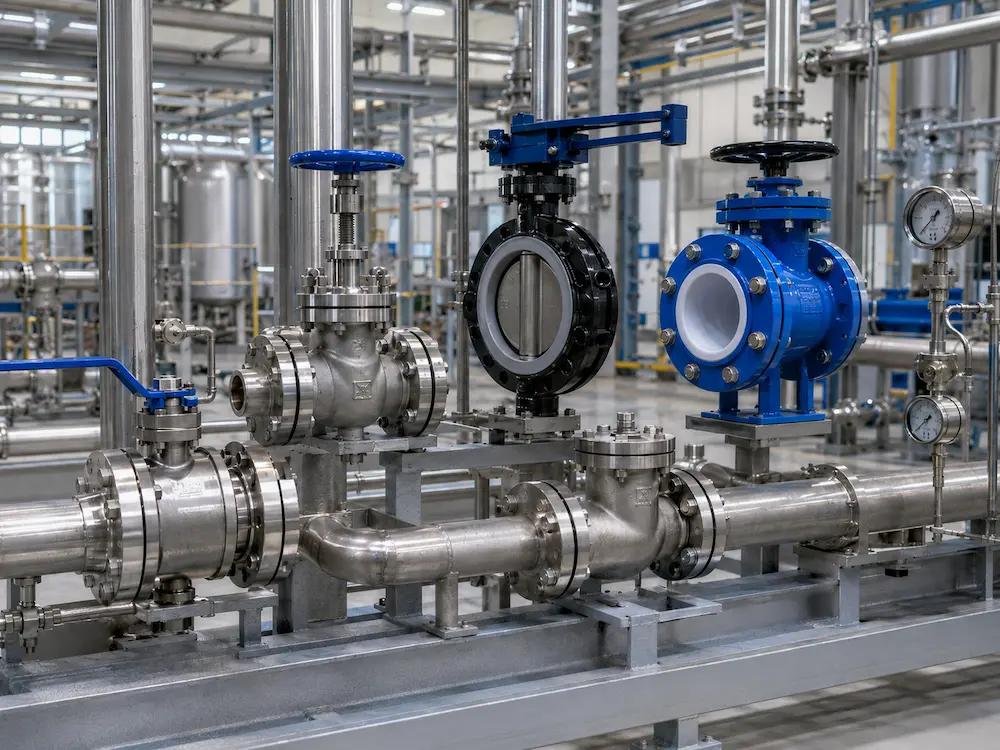
In dairy applications, diaphragm valves and globe/angle seat valves are the standard choices that meet PMO requirements. For dairy manufacturers exporting to the US, supplier product PMO compliance must be confirmed during the valve selection phase; failure to do so can result in the entire production line failing FDA plant audit review.
2. Special Challenges of Dairy Media
2.1 High Protein Residue and Biofilm Risk
Dairy products (milk, yoghurt, whey, etc.) contain high concentrations of protein and fat, which readily form protein deposit films on pipe walls and valve sealing surfaces. These deposits not only serve as breeding grounds for microorganisms but also form a "protective layer" during CIP cleaning, reducing cleaning efficiency.
Impact on valves:
Diaphragm surfaces on diaphragm valves are prone to protein film adhesion, requiring higher CIP frequency and stricter diaphragm material selection
Ball valve ball surfaces may experience increased operating torque due to protein deposits
Any minute roughness in the valve flow path can become a starting point for protein deposition
Design requirement: Surface finish requirements in the dairy industry are typically higher than in other beverage categories—internal surface Ra ≤ 0.4μm (electropolished) is the standard for biopharmaceutical-grade applications and is also widely adopted in high-end dairy products (infant formula, aseptic milk).
2.2 Fat Incompatibility with EPDM
Dairy products contain milk fat (butterfat) , with content varying by product (skim milk <0.5%, whole milk ~3.5%, cream >30%). Industry experience shows that EPDM seals swell and deform when in contact with media containing more than 8% fat content.
Selection implications:
Valve seals for products such as whole milk, cream, and butter cannot use EPDM
FKM (Viton) or PTFE seal materials should be selected instead
PTFE/EPDM composite diaphragms perform well in dairy diaphragm valves, but it must be confirmed that the EPDM layer of the composite material does not contact milk fat
2.3 Valve Selection for High-Viscosity Fluids
Yoghurt, cream, condensed milk, and other dairy products are high-viscosity non-Newtonian fluids, with flow characteristics vastly different from water and juice. High-viscosity media are prone to creating flow dead zones and residue in valves.
Selection recommendations:
For high-viscosity dairy products, diaphragm valves (straight-through) should be prioritised for their straight flow path, dead-leg-free design, and clog resistance
Ball valves should use full port design to avoid flow resistance and residue caused by reduced ports
Butterfly valve applications in high-viscosity media are already limited, and combined with PMO restrictions, they are essentially not recommended in dairy
3. Special Requirements for Dairy Diaphragm Valves
Diaphragm valves are the most critical valve type in the dairy industry, used for nearly all aseptic boundaries, tank inlets/outlets, and sampling points. Dairy diaphragm valve selection requires special attention to the following three points:
3.1 Hygienic Compliance of Diaphragm Materials
Diaphragm valve diaphragms directly contact the product, and materials must simultaneously meet:
FDA 21 CFR compliance (US market)
3-A Sanitary Standards hygienic design requirements
EHEDG certification for EU exports
PTFE/EPDM composite diaphragms are currently the mainstream choice in the dairy industry—the PTFE layer contacts the product (chemical-resistant, non-adsorbent), while the EPDM layer provides elastic sealing.
3.2 Diaphragm Replacement Frequency
Dairy CIP cleaning frequency is much higher than other beverage categories (typically after every batch), and CIP temperatures are higher (alkaline wash up to 85°C), causing faster diaphragm aging. Recommendations:
EPDM diaphragms: Replace every 1 year
PTFE/EPDM composite diaphragms: Replace every 1.5–2 years
Establish a preventative maintenance schedule for diaphragm replacement rather than waiting for leakage
3.3 SIP Sterilisation Compatibility
Aseptic milk and infant formula production lines typically require SIP (Steam-in-Place) . When selecting diaphragm valves, confirm that the diaphragm material can withstand 121–135°C saturated steam. PTFE/EPDM composite diaphragms typically meet this requirement.
4. Valve Configuration for Dairy CIP Systems
The key differences between dairy CIP systems and beverage CIP systems are higher cleaning temperatures and longer cleaning times.
| Parameter | Beverage Industry (General) | Dairy Industry |
|---|---|---|
| Alkaline wash temperature | 70–80°C | 80–85°C |
| Alkaline wash time | 20–30 minutes | 30–45 minutes |
| CIP frequency | Per shift or batch | After every batch |
| Cleaning concentration | 1–2% NaOH | 2–3% NaOH |
Impact on valves:
Seals on CIP switching valves (butterfly or ball valves) must withstand higher temperatures and longer chemical exposure
PTFE seals or PTFE/EPDM composite seals are recommended over standard EPDM
CIP line valves should use full port design to ensure high-flow cleaning solution scouring force
5. Dairy Valve Selection Matrix
| Application Scenario | Recommended Valve Type | Body/Seal Material | Special Requirements |
|---|---|---|---|
| Aseptic boundary/tank in/out | Diaphragm valve | 316L / PTFE/EPDM composite | PMO compliant, 3-A certified |
| Sampling point | Diaphragm valve | 316L / PTFE/EPDM composite | Dead-leg-free design, SIP-capable |
| Product transfer header | Globe/angle seat or ball valve (full port) | 316L / FKM or PTFE | Full port, fat swelling resistance |
| High viscosity (yoghurt/cream) | Diaphragm valve (straight-through) | 316L / PTFE/EPDM composite | Smooth flow path, clog-resistant |
| CIP supply/return | Butterfly valve (large diameter) or ball valve | 316L / PTFE | High-temperature CIP resistance; EPDM not suitable |
| CIP switching (multi-circuit) | 3-way ball valve | 316L / PTFE | High-temperature CIP chemical resistance |
| Steam sterilisation (SIP) | Diaphragm valve | 316L / PTFE/EPDM composite | Withstands ≥135°C steam |
Note: For non-product contact CIP supply/return headers, butterfly valves may still be used due to their significant cost advantage and exemption from PMO restrictions. However, seal material should be PTFE rather than EPDM to withstand higher CIP temperatures.
6. Summary of Key Differentiators for Dairy Valve Selection
Compared to general beverage selection, the four key differentiators for dairy valve selection are:
| Differentiator | Beverage Industry (General) | Dairy Industry |
|---|---|---|
| Butterfly valve use | Widely used | PMO-restricted for product contact; CIP circuits only |
| Seal material | EPDM primary | Avoid EPDM contact with milk fat; use FKM or PTFE |
| Surface finish | Ra ≤ 0.8μm | Ra ≤ 0.4μm (high-end dairy) |
| Valve preference | Butterfly/ball valves | Diaphragm valves (aseptic boundaries) / Globe/angle seat valves (product transfer) |


