


Sanitary Valve Actuator Selection Guide: Manual/Pneumatic/Electric/Positioner
In the food, pharmaceutical, biotech and water treatment industries, the actuator choice for sanitary valves (butterfly, ball, diaphragm) directly affects automation level, control precision, response speed and operational reliability of the production line. Incorrect actuator selection can result in sluggish valve operation, poor sealing, lost feedback signals, batch failures or product contamination.
This guide provides engineers with a complete sanitary valve actuator selection framework covering actuator types, torque calculation, control methods, environmental adaptability and certification requirements.
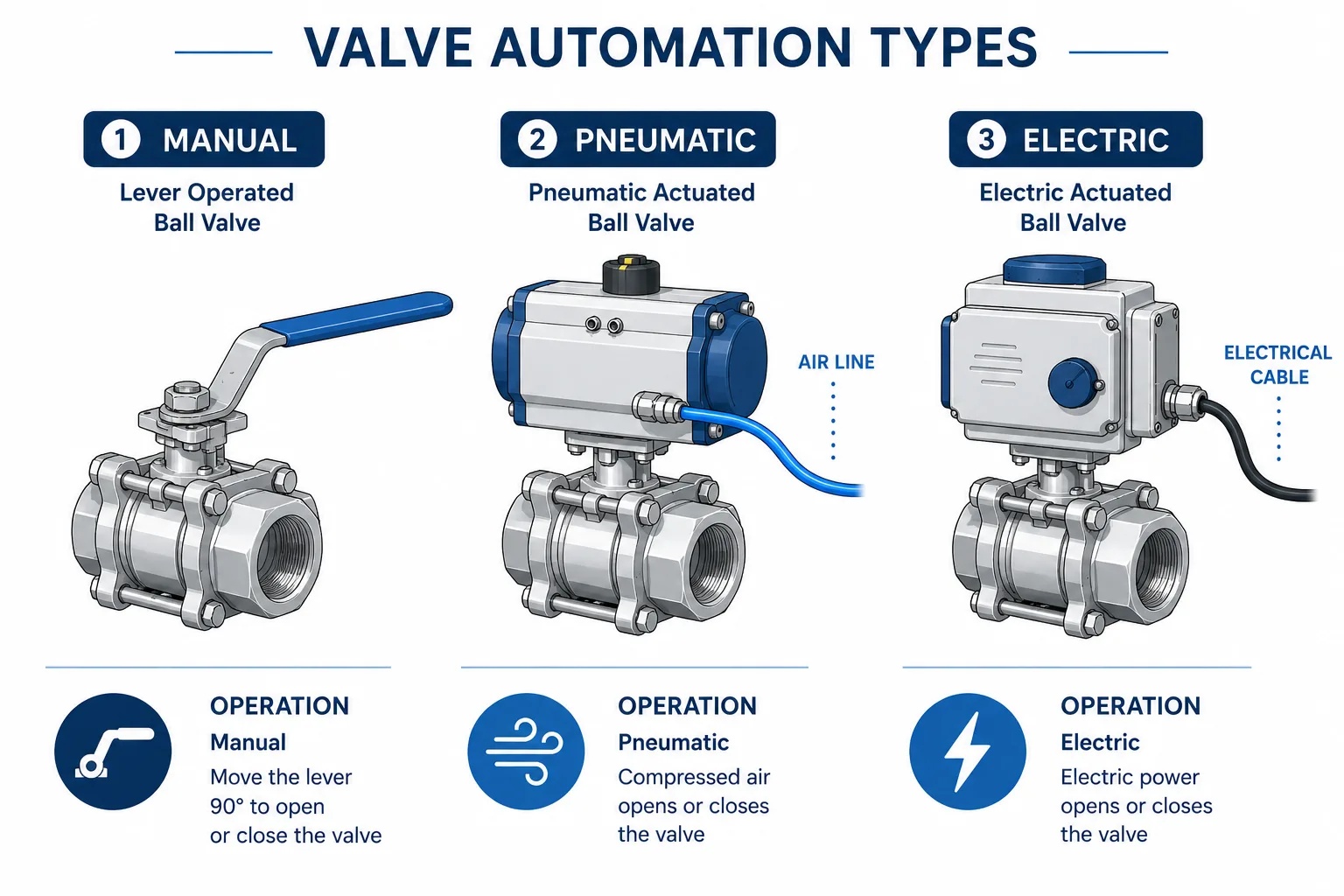
1. Actuator Type Overview
| Actuator Type | Operating Principle | Control Signal | Application | Relative Cost |
|---|---|---|---|---|
| Manual handle | Manual rotation/lever | None | Infrequent operation, commissioning, manual stations | Low |
| Manual gearbox | Gear reduction, handwheel | None | Large‑bore valves (≥DN80), high torque | Medium‑low |
| Pneumatic (spring return) | Air pressure with spring | On/off (air signal) | Fail‑safe (close/open on air loss), CIP circuits | Medium |
| Pneumatic (double acting) | Air pressure only | On/off (air signal) | Fast switching, high torque, no fail‑safe needed | Medium |
| Electric (on‑off) | Motor driven | On/off (dry contact/220V) | Sites without air supply, infrequent switching | Medium‑high |
| Electric (modulating) | Motor with position control | Analogue (4-20mA) | Precise flow modulation, no air supply | High |
| Pneumatic positioner | Pneumatic position control | Analogue (4-20mA) | Precise flow modulation, air supply available | Medium‑high |
| Smart electric actuator | Motor + control board | Bus (Profibus/Modbus) | DCS/PLC integration, remote monitoring, data logging | High |
2. Core Actuator Selection Parameters
2.1 Torque
Actuator output torque must exceed the valve’s maximum operating torque under all conditions.
| Influencing Factor | Effect on Torque | Safety Factor |
|---|---|---|
| Valve type | Butterfly: low; Ball: medium; Diaphragm: depends on diaphragm hardness | – |
| Valve size | Larger bore = higher torque | – |
| Media pressure | Higher pressure = higher sealing torque | 1.2–1.3x |
| Seat material | PTFE: low friction; EPDM: high friction | – |
| Temperature | High temperature may increase seal friction | 1.1–1.2x |
| Cycle frequency | High frequency requires fatigue consideration | 1.1x |
✅ Torque Selection Formula
Actuator output torque ≥ Valve operating torque × Safety factor (1.3–1.5 recommended)
2.2 Air Supply Requirements (Pneumatic Actuators)
| Parameter | Typical Value | Notes |
|---|---|---|
| Supply pressure | 4–8 bar | Must be regulated and filtered |
| Air quality | Dry, oil‑free, filtered to 5μm | Moist or oily air damages internal seals |
| Air consumption | Depends on actuator size and cycle frequency | Calculate for high‑frequency cycling |
| Solenoid voltage | 24V DC / 110V AC / 220V AC | Must match control system |
2.3 Power Requirements (Electric Actuators)
| Parameter | Typical Value | Notes |
|---|---|---|
| Supply voltage | 24V DC / 110V AC / 220V AC | Stable supply required |
| Control signal | On‑off: dry contact / Modulating: 4-20mA | Modulating requires positioner or smart board |
| Feedback signal | Limit switches (open/close) / 4-20mA position feedback | Essential for remote monitoring |
| Enclosure rating | IP65 / IP67 / IP68 | IP67+ recommended for wet environments |
2.4 Operating Speed
Typical operating times for different valve/actuator combinations:
| Valve Type | Actuator | Bore Size | Typical Operating Time |
|---|---|---|---|
| Butterfly | Pneumatic | DN50 | 0.5–1 second |
| Butterfly | Electric | DN50 | 3–10 seconds |
| Ball | Pneumatic | DN25 | 0.5–1 second |
| Ball | Electric | DN25 | 2–6 seconds |
| Diaphragm | Pneumatic | DN25 | 1–2 seconds |
3. Detailed Actuator Type Comparison
3.1 Manual Actuators
Manual handle
Advantages: Lowest cost, no power/air supply needed, simple and reliable, maintenance‑free
Disadvantages: No automation, no remote control, not suitable for high‑frequency operation
Applications: Commissioning, infrequent operation stations, backup valves
Manual gearbox
Advantages: Torque multiplication (5:1 to 50:1 reduction), handwheel operation
Disadvantages: Larger size, higher cost than handle
Applications: Large‑bore valves (≥DN80), high torque requirements
3.2 Pneumatic Actuators
Spring‑return (single acting)
Advantages: Fail‑safe (spring returns to preset position on air loss), no external spring needed
Disadvantages: Larger than double acting, slightly higher cost
Applications: CIP circuits, emergency shut‑off, safety‑related stations
Fail position: Normally closed (NC) or normally open (NO)
Double acting (no spring)
Advantages: Compact, higher torque, lower cost
Disadvantages: No fail‑safe (holds position on air loss)
Applications: Fast switching, high torque, where holding position on air loss is acceptable
Pneumatic actuator selection checklist:
Verify air supply pressure (4–8 bar)
Select solenoid valve type (single coil / double coil)
Confirm need for position feedback (limit switches / proximity sensors)
Confirm need for explosion protection (ATEX / flameproof)
3.3 Electric Actuators
On‑Off type
Advantages: No air supply needed, simple control (dry contact), easy installation
Disadvantages: Slow operating speed (3–10 seconds), poor modulation accuracy
Applications: Sites without air supply, infrequent switching, remote on/off control
Modulating type
Advantages: Precise position control (0–100%), 4-20mA feedback available
Disadvantages: Higher cost, complex commissioning
Applications: Processes requiring precise flow modulation (e.g., batching, pH control)
Smart type (Bus‑capable)
Advantages: Bus communication (Profibus/Modbus/DeviceNet), diagnostics, data logging
Disadvantages: Highest cost, requires DCS/PLC integration
Applications: Digital factories, fully integrated automation
3.4 Pneumatic Positioners
A positioner converts a 4-20mA control signal into a pneumatic signal (3-15 psi / 0.2-1 bar) for precise valve position control.
| Positioner Type | Operating Principle | Accuracy | Application |
|---|---|---|---|
| Mechanical positioner | Force balance / nozzle‑flapper | ±1–2% | General modulating applications |
| Smart positioner | Microprocessor control, auto‑calibration | ±0.5–1% | Pharma, fine chemicals, high‑precision modulation |
| Bus positioner | Profibus/FF/Modbus | ±0.5% | DCS integration, digital factories |
4. Selection Decision Flowchart
The following decision process helps quickly determine the actuator type:
┌─────────────────────────────────────────────────────────────┐
│                 Step 1: Is automation needed?                │
└─────────────────────────────────────────────────────────────┘
                    │                    │
                   No                    Yes
                    ▼                    ▼
           ┌──────────────┐      ┌─────────────────────────────┐
           │    Manual     │      │   Step 2: Is air supply     │
           │   Actuator    │      │        available?           │
           │ Handle/Gearbox│      └─────────────────────────────┘
           └──────────────┘                 │                    │
                                            No                   Yes
                                            ▼                    ▼
                                ┌─────────────────┐      ┌─────────────┐
                                │    Electric     │      │  Pneumatic  │
                                │    Actuator     │      │  Actuator   │
                                └─────────────────┘      └─────────────┘
                                         │                        │
                                         ▼                        ▼
                                ┌─────────────────┐      ┌─────────────────────┐
                                │ Modulating      │      │ Fail‑safe required? │
                                │ control needed? │      │ (close/open on      │
                                │ (4-20mA)        │      │  air loss)          │
                                └─────────────────┘      └─────────────────────┘
                                         │                    │           │
                                        Yes         No         Yes         No
                                        ▼           ▼          ▼           ▼
                                ┌───────────┐ ┌───────┐ ┌───────────┐ ┌───────────┐
                                │Modulating │ │On‑Off │ │ Spring‑   │ │ Double    │
                                │Electric   │ │Electric│ │ Return    │ │ Acting    │
                                │Actuator   │ │       │ │ Pneumatic │ │ Pneumatic │
                                └───────────┘ └───────┘ └───────────┘ └───────────┘
5. Actuator-to-Valve Pairing Recommendations
| Valve Type | Bore Size Range | Recommended Actuator | Notes |
|---|---|---|---|
| Butterfly (concentric) | DN25–DN150 | Pneumatic (S/D), Electric | Lower torque, pneumatic preferred |
| Butterfly (double‑offset) | DN50–DN300 | Pneumatic (DA) or Electric | Higher torque, gearbox recommended |
| Ball (full port) | DN15–DN100 | Pneumatic (SR), Electric | Medium torque, sealing torque critical |
| Diaphragm (weir) | DN8–DN100 | Pneumatic (SR), Manual | Spring‑return recommended (fail‑safe) |
| Diaphragm (straight) | DN15–DN80 | Pneumatic (SR), Manual | Slightly higher torque than weir |
6. Special Environments & Certifications
6.1 Explosion Protection (Ex)
For locations with flammable gases or dust (e.g., alcohol storage, solvent mixing rooms), actuators require explosion‑proof certification.
| Ex Level | Application | Common Certifications |
|---|---|---|
| Ex d (flameproof) | Zone 1, Zone 2 | ATEX, IECEx, CNEx |
| Ex mb (encapsulated) | Zone 1, Zone 2 | ATEX |
| Ex nA (non‑sparking) | Zone 2 | ATEX |
6.2 Ingress Protection (IP)
| IP Rating | Protection | Environment |
|---|---|---|
| IP65 | Dust‑tight, water jets | General indoor |
| IP67 | Dust‑tight, temporary immersion | Wet environments, washdown areas |
| IP68 | Dust‑tight, continuous immersion | Outdoor, underground |
✅ Food/Pharma Recommendation: Actuator enclosure rating should be at least IP67 to withstand daily washdown and CIP environments.
6.3 Materials & Surface Finish
Actuator body: Aluminium alloy anodised (standard), SS316L (high‑corrosion environments)
Fasteners: Stainless steel
Seals: NBR (standard), FKM (high‑temperature/chemicals), EPDM (CIP environments)
6.4 FDA / USP Compliance
For actuator components that contact the product (e.g., diaphragm valve compressor), FDA 21 CFR or USP Class VI compliance may be required. The actuator body typically does not contact the product and does not require FDA certification, but surfaces should be easy to clean.
7. Common Selection Mistakes
❌ “More torque is always safer”
Excessive torque can damage valve seals and stems. Actuator torque should precisely match valve requirements – a safety factor of 1.3–1.5 is recommended.
❌ “Pneumatic actuators are always better than electric”
Pneumatic actuators are fast and suitable for high cycling, but require an air supply and filtration. For sites without air supply, electric actuators are the better choice.
❌ “Spring‑return actuators are always better”
Spring‑return actuators are larger and more expensive. Choose spring‑return only when fail‑safe (close/open on air loss) is required.
❌ “Standard electric actuators can be used for modulation”
Standard on‑off electric actuators overheat with frequent cycling and have poor accuracy. For modulating control, a modulating electric actuator or positioner is essential.
❌ “Environmental temperature doesn’t affect actuators”
Pneumatic actuator seals harden at low temperatures; electric actuator motors may overheat at high temperatures. Select appropriate materials and enclosure ratings for the ambient temperature.
8. Actuator Maintenance & Troubleshooting
| Symptom | Possible Cause | Solution |
|---|---|---|
| Pneumatic actuator slow | Low air pressure, clogged filter, solenoid fault | Check air supply, replace filter element, check solenoid |
| Pneumatic actuator leaks | Worn seals, scratched cylinder bore | Replace seals, inspect cylinder bore |
| Electric actuator not moving | Power loss, motor thermal protection, limit switch fault | Check power supply, allow cooling, check limit switch |
| Electric actuator inaccurate positioning | Control signal interference, potentiometer wear | Shield signal wires, replace potentiometer |
| Manual handle stuck | Bent stem, swollen seals | Inspect valve, replace seals |
9. Why Choose Engineering Plumbing as Your Actuator Supplier?
At Engineering Plumbing, we provide complete actuator solutions for sanitary valves:
Manual actuators: Stainless steel/aluminium handles, handwheel gearboxes
Pneumatic actuators: Spring‑return / double acting, ATEX optional, with solenoids, limit switches, positioners
Electric actuators: On‑off / modulating / smart type, 4-20mA control and feedback, bus communication optional
Positioners: Mechanical, smart, bus type – 4-20mA input, pneumatic output
Accessories: Solenoid valves (5/2, 5/3), limit switches (mechanical/proximity), filter regulators, air pilot valves
Quality assurance: 100% function test + leak detection
📞 Actuator Selection Consultation
Send your valve parameters (valve type, bore size, media pressure, cycle frequency, control requirements, site conditions) to our engineering team. We will reply with a complete actuator configuration proposal within 48 hours.
Frequently Asked Questions (FAQ)
1. How do I calculate the required valve torque?
Valve torque = Sealing torque + Friction torque + Media pressure torque. Measure the valve torque or request a torque curve from the valve manufacturer. Actuator output torque should be at least 1.3 times the valve torque.
2. How do I choose between spring‑return and double‑acting pneumatic actuators?
Spring‑return: When fail‑safe is required (valve closes or opens automatically on air loss)
Double acting: When fail‑safe is not required, or when holding position on air loss is acceptable
3. What is the positioning accuracy of electric actuators?
On‑off type: No modulation capability
Modulating type (with potentiometer/encoder): ±1–2%
Smart type (with PID control board): ±0.5–1%
4. What is the difference between a pneumatic positioner and a modulating electric actuator?
| Characteristic | Pneumatic Positioner + Pneumatic Actuator | Modulating Electric Actuator |
|---|---|---|
| Air supply needed | Yes | No |
| Accuracy | High (smart positioner ±0.5%) | High (±0.5–1%) |
| Response speed | Fast | Slow |
| Cost | Medium‑high | High |
| Application | Modulating with air supply | Modulating without air supply |
5. How do I choose the actuator enclosure rating?
General indoor: IP65
Wet/washdown areas: IP67 (recommended for food/pharma)
Outdoor/submersion: IP68
6. Can you supply ATEX certified actuators?
Yes. Both our pneumatic and electric actuators are available with ATEX and IECEx certification for Zone 1, Zone 2, Zone 21 and Zone 22.
7. How are actuators mounted to valves?
Direct mounting: ISO 5211 standard interface (most common)
Bracket mounting: For non‑standard interfaces using mounting brackets and couplings
NAMUR interface: Solenoid valve mounting standard for pneumatic actuators
8. What is the typical service life of an actuator?
Manual actuators: Nearly unlimited (except seals)
Pneumatic actuators: 1–2 million cycles (seals require periodic replacement)
Electric actuators: 100,000–500,000 cycles (motor and gear life)


