


Sanitary Gasket & Seal Selection Guide
In the food, pharmaceutical, biotech and fine chemical industries, gaskets and seals are the most critical yet most vulnerable components in sanitary piping systems. Although they are small and represent a low percentage of total cost, they directly determine system sealing reliability, product safety, CIP/SIP cleaning effectiveness, and overall service life.
An unsuitable seal can cause micro‑leaks, product contamination, batch failures, or even food safety and drug quality incidents. This guide provides engineers with a complete selection framework covering seal types, material comparison, hygienic design principles, certification requirements, selection processes and maintenance strategies.
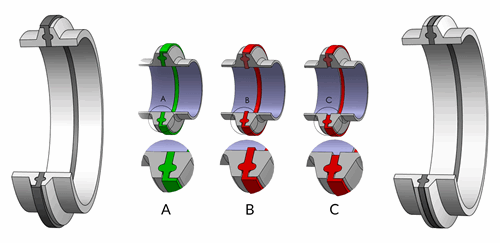
1. Types and Functions of Sanitary Seals
In sanitary systems, the most commonly used seal type is the Tri‑clamp gasket (Sanitary Gasket) . It is a ring‑shaped sealing element specifically designed for clamp connections, installed between the end faces of two ferrules. The outer clamp applies compressive force, creating a uniform seal that meets hygienic standards such as FDA, 3‑A and EHEDG.
Core functions of sanitary seals:
| Function | Description |
|---|---|
| Leak‑tight sealing | Forms a reliable barrier between ferrule faces to prevent fluid leakage or external contamination |
| Withstand cleaning & sterilisation | Must endure the harsh conditions of CIP and SIP processes |
| Non‑contaminating | Must not leach harmful substances, shed particles, or alter product flavour or purity |
| Easy to clean | Smooth surfaces, no dead legs, no microbial growth |
Main types of sanitary seals:
| Type | Standard | Typical Application |
|---|---|---|
| Tri‑clamp gasket | ISO 2852, ASME BPE, DIN 32676 | Most common in food, pharma, biotech |
| Threaded joint gasket | DIN 11851, SMS 1149 | Sanitary threaded connections |
| Flange gasket | ASME B16.5, EN 1092 | Large‑bore or high‑pressure systems |
2. Seal Material Comparison & Selection
The performance of sealing materials directly determines gasket service life and sealing effectiveness. The following five materials are the most common in sanitary systems.
2.1 Material Performance Overview
| Material | Temp Range (°C) | Best Applications | Media to Avoid | Relative Cost | FDA Compliant |
|---|---|---|---|---|---|
| EPDM | -54 ~ +149 | Steam, hot water, alkaline CIP | Oils, hydrocarbon solvents | $ | 21 CFR 177.2600 |
| Silicone (VMQ) | -54 ~ +232 | Food contact, high flexibility | Steam, strong acids/alkalis, oils | $$ | 21 CFR 177.2600 |
| PTFE | -38 ~ +260 | Strong acids, organic solvents, high‑purity water | Strong alkalis at high temperatures | $$ | 21 CFR 177.1550 |
| FKM (Viton) | -34 ~ +204 | High temperature, oils, chemicals | Amines, ketones, live steam | $$$ | Formulation‑dependent |
| NBR (Buna‑N) | -34 ~ +93 | Water, oil, CO₂, general use | Strong acids, ozone | $ | Some grades |
Temperature range note: Values above are typical working ranges – actual performance depends on specific formulations.
2.2 Material Deep Dive
EPDM – The Steam & CIP Specialist
EPDM excels in steam and hot water applications, making it the preferred elastomer for SIP systems. It resists alkaline CIP solutions, ozone and UV aging.
✅ Recommended for: CIP circuits, hot water lines, steam sterilisation systems
❌ Avoid with: Oils and petroleum products (causes swelling)
Silicone (VMQ) – The Flexible Food‑Contact Choice
Silicone is one of the most popular materials in food and pharmaceutical industries – non‑toxic, tasteless and flexible. Platinum‑cured silicone offers higher purity, eliminating residual by‑products like benzoic acid associated with traditional peroxide curing. It is suitable for biopharma and ultrapure water systems.
✅ Recommended for: Food contact surfaces, frequent disassembly connections, biopharma
❌ Avoid with: Steam lines, strong acids/alkalis, oil contact
PTFE – The Chemical Resistance All‑Rounder
PTFE offers nearly universal chemical compatibility – the most corrosion‑resistant sealing material. It does not leach or adsorb, making it ideal for high‑purity and corrosive media. However, PTFE is prone to “cold flow” (creep) under sustained compression – regular re‑torquing of clamps is required.
✅ Recommended for: Strong acids, organic solvents, high‑purity water/WFI
⚠️ Note: Low elasticity – requires sufficient clamp pressure
FKM (Viton) – High Temperature & Oil Applications
FKM excels in high‑temperature and oil‑based media, but is not recommended for steam applications and is incompatible with amines and ketones.
2.3 Application‑Based Quick Selection
| Application | Recommended Material | Reason |
|---|---|---|
| Steam sterilisation (SIP) | EPDM or PTFE | EPDM resists steam, PTFE resists high temp |
| Alkaline CIP | EPDM | Resists strong alkalis and hot water |
| Strong acid transfer | PTFE | Best chemical compatibility |
| Direct food contact | Silicone or PTFE | FDA compliant, odourless, no leachables |
| Oil/fat‑containing media | FKM or PTFE | Oil‑resistant |
| Biopharma / WFI | Silicone (platinum‑cured) or PTFE | USP Class VI, low extractables |
| Frequent disassembly | Silicone | Flexible, easy to install |
3. Hygienic Design & Certification Requirements
3.1 Key Certification Standards
Sanitary seals must meet a series of strict industry certification requirements:
| Certification/Standard | Applicable Scope | Core Requirements |
|---|---|---|
| FDA 21 CFR | US food and drug contact materials | Material safety, composition compliance (177.1550/177.2600) |
| USP Class VI | Pharma, biotech | Biocompatibility testing (in vivo + in vitro) |
| 3‑A Sanitary Standards | Food, dairy, pharma | Hygienic design, cleanability |
| EHEDG | European food, pharma | Hygienic engineering & design certification |
| EU 1935/2004 | European food contact materials | No harmful substance migration into food |
3.2 FDA & USP Compliance Explained
FDA 21 CFR 177.2600: Applies to elastomers such as EPDM and silicone – confirms material can be used in repeated‑use rubber articles
FDA 21 CFR 177.1550: Applies to PTFE materials
USP Class VI: The most stringent biocompatibility standard. The pharmaceutical industry typically requires seals to pass USP Class VI to ensure no toxic reactions when contacting drugs
3.3 Traceability & Batch Management
Sanitary seals should have complete traceability – each batch must have a unique batch number traceable to raw materials, cure batch and inspection records. This is a fundamental requirement of cGMP and ASME BPE.
4. Maintenance & Replacement Intervals
Seals are consumables. Regular replacement is essential to maintain system sealing performance and sterility.
| Material | Recommended Replacement Interval | Influencing Factors |
|---|---|---|
| EPDM | 1-2 years | CIP/SIP frequency, temperature, chemical concentration |
| Silicone | 1-2 years | UV exposure, ozone, frequent disassembly |
| PTFE | 2-3 years | Compression cycles (cold flow) |
| FKM | 2-3 years | Temperature cycling, chemical compatibility |
Inspection checkpoints: Every time a clamp connection is opened, inspect the seal for the following signs:
Permanent deformation (loss of elasticity)
Surface cracking
Hardening or softening
Chemical corrosion or swelling
5. Common Selection Errors & Solutions
| Error | Consequence | Solution |
|---|---|---|
| Using standard rubber gaskets instead of sanitary grade | Contaminant leach into product, CIP‑intolerant | Select FDA/USP compliant sanitary seals |
| Using EPDM with oil‑containing media | EPDM swells, seal fails | Switch to FKM or PTFE |
| Using silicone for steam sterilisation | Silicone ages rapidly in steam | Switch to EPDM or PTFE |
| Not re‑torquing PTFE gaskets regularly | Cold flow leads to leakage | Establish regular re‑torquing programme |
| Ignoring USP Class VI requirements | Pharma audit failure | Confirm material passes USP Class VI |
| Seals without batch traceability | Cannot match MTR/FDA certificates | Choose traceable supplier |
6. Why Choose Engineering Plumbing for Sealing Solutions?
At Engineering Plumbing, we provide complete sealing solutions for sanitary systems:
Full material range: EPDM, silicone, PTFE, FKM, NBR – covering all sanitary applications
Certification support: All products come with FDA 21 CFR compliance statements; PTFE/silicone pass USP Class VI
Traceability: Each batch has a unique batch number with MTR and compliance certificates available
Customisation: Non‑standard sizes available per ASME BPE, ISO 2852, DIN 32676
Selection support: Material recommendations based on your media, temperature and cleaning conditions
📞 Seal Selection Consultation
Send your process parameters (media type, temperature, pressure, CIP/SIP frequency) to our engineering team. We will return a seal recommendation within 48 hours.
Frequently Asked Questions (FAQ)
1. How do I select the correct gasket size for a Tri‑clamp connection?
Tri‑clamp gasket size is determined by the ferrule standard (e.g., ISO 2852 or ASME BPE) and pipe nominal diameter (DN) . When ordering, confirm: ferrule standard, pipe size, and gasket ID alignment with pipe ID (to prevent ledge dead legs).
2. How do I choose between EPDM and silicone?
EPDM: Suitable for steam, hot water, alkaline CIP – but not oil‑resistant
Silicone: Suitable for food contact, frequent disassembly – but not steam or strong acids
3. Do PTFE gaskets require regular re‑torquing?
Yes. PTFE is prone to cold flow (creep) under sustained compression, which reduces sealing force. It is recommended to re‑torque clamps after initial system heat‑up and inspect periodically thereafter.
4. Why is USP Class VI certification important?
USP Class VI is the most stringent biocompatibility standard for materials. It confirms, through in vivo and in vitro testing, that materials do not cause toxic reactions when contacting drugs. For pharma and biotech, this is a compliance requirement.
5. How often should seals be replaced?
There is no fixed standard – depends on material, operating conditions and disassembly frequency. Recommended: inspect seal condition every time a connection is opened; replace immediately if deformation, cracking or hardening is found. For critical aseptic processes, establish a preventative replacement schedule (e.g., every 1-2 years).
6. What do different gasket colours mean?
Colours typically indicate material:
White/translucent: PTFE or silicone (food grade)
Black: EPDM, FKM or NBR
Blue: Typically silicone (for visual detection)
However, colour alone is not a reliable material identifier – always rely on batch labels and certificates.


