


Sanitary Project Lifecycle Management Overview
In the food, pharmaceutical, biotech and water treatment industries, a sanitary project from concept inception to system decommissioning typically spans 10–30 years or more. Throughout this long journey, Lifecycle Management is the key to sustainable project success – it focuses not only on initial construction costs but also on operational efficiency, maintenance costs, compliance and final decommissioning.
This guide divides the sanitary project lifecycle into eight stages, systematically outlining the core work, key deliverables and common pitfalls of each stage, and providing a clear navigation index for the 22 topics in this article series.
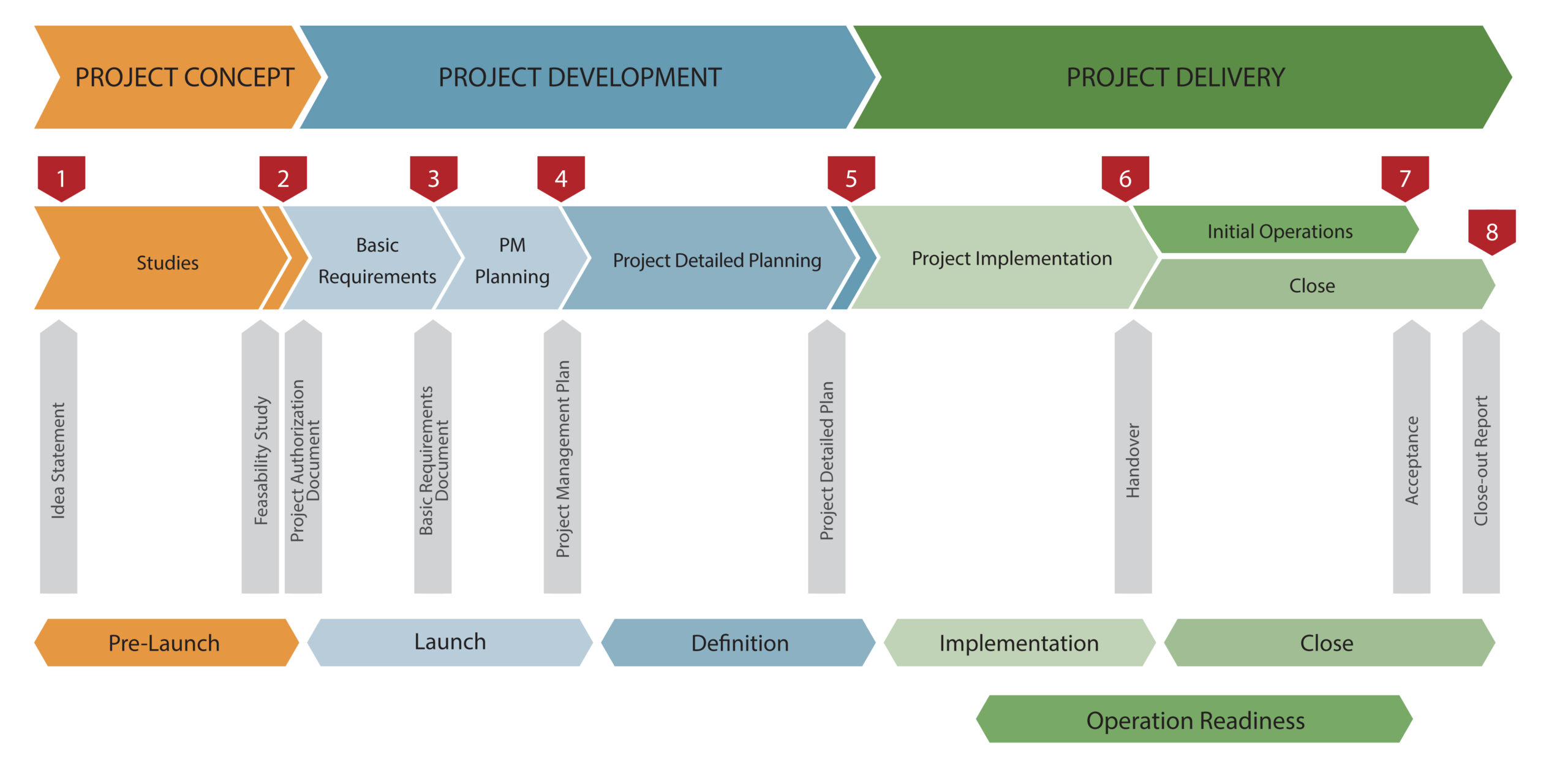
1. Core Concepts of Lifecycle Management
1.1 What is Lifecycle Management?
Lifecycle management is a systematic project management approach that focuses on every stage of a project from concept to decommissioning. For sanitary systems, this approach is particularly important because the system must not only meet design specifications at construction but also continuously satisfy product quality and compliance requirements over decades of operation.
1.2 Lifecycle Cost (LCC) Thinking
Lifecycle cost includes not only the cost of building the system but also short‑term and long‑term maintenance costs, replacement costs, expansion and upgrade costs, as well as indirect support costs (such as capacity building, planning and monitoring). The service life of infrastructure components varies greatly – civil structures up to 50 years, mechanical equipment approximately 30 years, and electrical and control systems approximately 20 years.
2. Stage 1: Concept Design & Feasibility Study
2.1 Core Work
| Work Content | Description |
|---|---|
| Requirements identification | Define production requirements, capacity targets and product specifications |
| Preliminary technical solution | Determine process route, system scale and major equipment selection direction |
| Regulatory applicability assessment | Identify applicable standards (FDA 21 CFR, 3‑A, EHEDG, ASME BPE, etc.) |
| Budget estimation | Preliminary investment estimation and ROI analysis |
2.2 Key Deliverables
User Requirements Specification (URS) – defines what the system must achieve
Feasibility study report
Preliminary project budget
2.3 Common Pitfalls
| Pitfall | Consequence | Solution |
|---|---|---|
| Incomplete URS | Design changes during detailed engineering, leading to rework and cost overruns | Invest sufficient time in developing comprehensive URS |
| Ignoring regulatory requirements | Subsequent design fails to meet compliance | Engage regulatory experts early |
3. Stage 2: Detailed Engineering & Design
3.1 Core Work
| Work Content | Description |
|---|---|
| Process design | P&ID, mass balance, heat balance |
| Equipment selection | Technical specifications for pumps, valves, heat exchangers, tanks |
| Piping design | Pipe sizing, velocity design, slope planning, support design |
| Hygienic design review | Dead leg analysis (L/D ratio), cleanability assessment, surface finish specification |
| Quality control procedures | Develop quality assurance procedures during detailed design, defining responsibilities at each stage |
3.2 Key Deliverables
Design Qualification (DQ) documentation package
Detailed P&ID drawings
Equipment technical specifications
User Requirements Specification (URS) – the core basis for design and procurement
3.3 Key Considerations
Hygienic design must be incorporated from the outset. Problems solved during the design phase cost far less than those discovered and fixed later. Design should undergo multiple reviews – at least two rounds of external expert review is industry best practice, and at least three comprehensive reviews are recommended.
3.4 Common Pitfalls
| Pitfall | Consequence | Solution |
|---|---|---|
| Dead legs not identified at design stage | Difficult to retrofit later | Conduct comprehensive dead leg analysis at design stage |
| Surface finish requirements not specified | Equipment cannot meet requirements after procurement | Clearly specify Ra value requirements in design specifications |
| Ignoring CIP cleanability | CIP system performs poorly | Simulate CIP cleaning paths during design |
Related articles:
Dead Leg Analysis & Elimination Methods in Sanitary System Design
Flow Velocity & Pressure Drop Calculation in Sanitary System Design
Sanitary Pipe Connection Methods Comparison
4. Stage 3: Procurement & Manufacturing
4.1 Core Work
| Work Content | Description |
|---|---|
| Supplier management | Supplier evaluation, tendering, contract negotiation |
| Material traceability | Ensure all materials are traceable (MTR, COC) |
| Manufacturing supervision | Factory Acceptance Testing (FAT) for critical equipment |
| Quality control | Material inspection, manufacturing process inspection |
4.2 Key Deliverables
Material Test Reports (MTR) and Certificates of Conformance (COC)
Factory inspection reports
Supplier documentation package (operation manuals, maintenance manuals)
4.3 Common Pitfalls
| Pitfall | Consequence | Solution |
|---|---|---|
| MTR does not match actual material | Validation failure, no traceability | Verify material identification and certificates against physical items upon receipt |
| Equipment delivery delays | Overall project schedule impacted | Clearly specify delivery dates and penalties in contracts |
Related articles:
Material Traceability & Certification Document Management for Sanitary Systems
Stainless Steel vs. Brass vs. Plastic Manifolds – A Comparative Analysis
5. Stage 4: Installation & Construction
5.1 Core Work
| Work Content | Description |
|---|---|
| Pipe installation | Pipe connections (tri‑clamp, welded, threaded, flanged), support installation |
| Equipment positioning | Installation of pumps, valves, tanks, heat exchangers |
| Slope control | Ensure pipe slopes meet design requirements (process ≥1%, CIP return ≥2%) |
| Welding quality | Orbital or manual TIG welding with strict argon purge protection |
| Quality control | Quality inspection and documentation during installation |
5.2 Key Deliverables
As‑built drawings
Welding log (each weld: number, welder, parameters, inspection results)
Installation checklist (signed)
Pipe support installation records
5.3 Common Pitfalls
| Pitfall | Consequence | Solution |
|---|---|---|
| Internal weld oxidation | Reduced corrosion resistance, compromised hygienic performance | Strictly enforce argon purge procedures |
| Pipe sagging | Low‑point pooling zones | Ensure support spacing meets design requirements |
| Incomplete welding documentation | Traceability issues during validation | Record welding log concurrently with installation |
Related articles:
Sanitary Pipe Connection Methods Comparison
Sanitary Pipe Support & Installation Standards
Sanitary Pipe Welding Quality Inspection & Acceptance Standards
6. Stage 5: Commissioning & Validation (IQ/OQ/PQ)
6.1 Core Work
Commissioning and validation are critical steps to ensure the system operates as designed and are mandatory for regulatory compliance.
| Phase | Core Content | Acceptance Criteria |
|---|---|---|
| System flushing | Remove debris and contaminants from piping | Flush water clear, strainer debris‑free |
| Installation Qualification (IQ) | Verify system installed as designed | All installation checklist items pass |
| Operational Qualification (OQ) | Verify system operates as specified | CIP/SIP parameters, alarm/interlock tests pass |
| Performance Qualification (PQ) | Verify consistent production of quality product | Three‑batch validation passes |
| Disinfection verification | Confirm system is disinfected | Microbiological tests pass |
6.2 Key Deliverables
Commissioning plan and report
Flushing records
IQ/OQ/PQ protocols and reports
Disinfection records and water quality test reports
Validation Summary Report (VSR)
6.3 Common Pitfalls
| Pitfall | Consequence | Solution |
|---|---|---|
| Insufficient flushing | Debris residue affects subsequent validation | Ensure flush volume ≥3× system volume |
| Incomplete IQ documentation | Audit findings | Complete all documentation during IQ phase |
| OQ not testing worst‑case conditions | PQ phase failure | Test upper and lower operating limits during OQ |
Related articles:
Sanitary System Commissioning & Startup Guide
Sanitary System Validation & Re‑validation Guide (IQ/OQ/PQ)
Pressure Testing & Acceptance Standards for Sanitary Valves and Piping
7. Stage 6: Operation & Maintenance
7.1 Core Work
After system startup, the system enters its longest phase – operation and maintenance.
| Work Content | Frequency | Description |
|---|---|---|
| Daily inspections | Per shift | Inspection of pumps, valves, instruments, piping, tanks |
| Preventative maintenance | Weekly/monthly/quarterly/annual | Lubrication, calibration, seal replacement, filter replacement |
| CIP/SIP execution | Per batch | Execution of cleaning and sterilisation procedures |
| Troubleshooting | As needed | Pump faults, valve leakage, CIP failures, etc. |
7.2 Key Deliverables
Operation inspection logs (per shift)
Maintenance work orders and records
CIP/SIP execution records (temperature profile, concentration, time)
Spare parts replacement records (batch number, supplier)
7.3 Common Pitfalls
| Pitfall | Consequence | Solution |
|---|---|---|
| Seals not replaced regularly | Leakage, contamination | Establish preventative replacement schedule |
| Incomplete maintenance records | Audit findings, traceability issues | Establish standardised recording processes |
| Poor spare parts management | No parts available when needed | Establish spare parts inventory management system |
Related articles:
Sanitary System Operation, Maintenance & Troubleshooting Guide
Sanitary Gasket & Seal Selection Guide
8. Stage 7: Energy Optimisation & Continuous Improvement
8.1 Core Work
During system operation, continuous energy optimisation is key to reducing operating costs and carbon footprint.
| Work Content | Description | Saving Potential |
|---|---|---|
| Pump system optimisation | VFD retrofits, impeller trimming | 30–50% |
| CIP system optimisation | Parameter optimisation, recovery tanks, turbidity sensors | Water 20–40%, energy 15–30% |
| Heat recovery | Steam condensate preheating | 15–25% |
| Compressed air optimisation | Leak detection, pressure reduction | 15–30% |
8.2 Key Deliverables
Energy baseline report
Energy optimisation proposal
Energy savings verification report
8.3 Common Pitfalls
| Pitfall | Consequence | Solution |
|---|---|---|
| No measurement = no management | Cannot assess improvement effectiveness | Establish energy monitoring system |
| Energy savings not verified | Difficult to justify investment | Record pre‑ and post‑retrofit energy data |
Related articles:
Sanitary System Energy Efficiency Optimisation Guide
9. Stage 8: Modification & Decommissioning
9.1 Core Work
When the system reaches the end of its service life, capacity becomes insufficient, or regulations change, modification or final decommissioning may be required.
| Work Content | Description |
|---|---|
| System assessment | Evaluate system condition, remaining life and upgrade potential |
| Modification design | Partial upgrade or expansion design |
| Re‑validation | Modified systems require re‑validation |
| Decommissioning | System shutdown, equipment removal, environmental clearance |
9.2 Key Deliverables
System condition assessment report
Modification proposal
Re‑validation documentation package
Decommissioning report
9.3 Common Pitfalls
| Pitfall | Consequence | Solution |
|---|---|---|
| Modifications not considering compatibility with existing system | Interface mismatch | Conduct detailed interface analysis before modification |
| Contamination not addressed during decommissioning | Environmental impact | Develop decommissioning plan including environmental clearance |
Related articles:
Sanitary System Validation & Re‑validation Guide (IQ/OQ/PQ) – Re‑validation section
10. Documentation Requirements Across Lifecycle Stages
Documentation is the thread that runs through the entire lifecycle. The following table summarises key documents for each stage:
| Stage | Key Documents |
|---|---|
| Concept design | URS, feasibility report, project budget |
| Detailed engineering | DQ report, P&ID, equipment specifications, design review reports |
| Procurement | MTR, COC, factory inspection reports |
| Installation | As‑built drawings, welding log, installation checklist |
| Commissioning & validation | Flushing records, IQ/OQ/PQ protocols and reports, VSR |
| O&M | Inspection logs, maintenance work orders, CIP/SIP records, spare parts records |
| Energy optimisation | Energy baseline, optimisation proposal, savings verification |
| Modification & decommissioning | Condition assessment, modification proposal, decommissioning report |
11. Article Series Index
This series comprises 22 articles, organised according to the natural knowledge structure of sanitary projects:
1. Product & Equipment Selection
| No. | Article Title | Corresponding Stage |
|---|---|---|
| 1 | The Ultimate Guide to Stainless Steel Manifolds for Water Treatment Systems | Detailed engineering |
| 2 | How to Select a Sanitary Ball Valve Supplier for Food & Beverage Plants | Detailed engineering |
| 3 | Why Stainless Steel Manifolds Are Critical for Data Center Cooling Efficiency | Detailed engineering |
| 4 | Stainless Steel vs. Brass vs. Plastic Manifolds – A Comparative Analysis | Detailed engineering |
| 5 | Sanitary Butterfly Valve Selection Guide for Food, Pharma & Biotech | Detailed engineering |
| 6 | Sanitary Diaphragm Valve – The Best Choice for Aseptic Processes | Detailed engineering |
| 7 | Sanitary Valve Actuator Selection Guide | Detailed engineering |
| 8 | Sanitary Pipe Connection Methods Comparison | Detailed engineering |
| 9 | Sanitary Gasket & Seal Selection Guide | Detailed engineering |
| 10 | Centrifugal Pump vs. Rotary Lobe Pump vs. Diaphragm Pump | Detailed engineering |
2. System Design
| No. | Article Title | Corresponding Stage |
|---|---|---|
| 11 | Dead Leg Analysis & Elimination Methods in Sanitary System Design | Detailed engineering |
| 12 | Flow Velocity & Pressure Drop Calculation in Sanitary System Design | Detailed engineering |
| 13 | Sanitary Pipe Support & Installation Standards | Detailed engineering |
3. Installation & Construction
| No. | Article Title | Corresponding Stage |
|---|---|---|
| 14 | Sanitary Pipe Welding Quality Inspection & Acceptance Standards | Installation |
4. Commissioning & Validation
| No. | Article Title | Corresponding Stage |
|---|---|---|
| 15 | CIP/SIP System Valve Configuration & Selection Guide | Detailed engineering/Commissioning |
| 16 | Pressure Testing & Acceptance Standards for Sanitary Valves and Piping | Commissioning & validation |
| 17 | Sanitary System Commissioning & Startup Guide | Commissioning & validation |
| 18 | Sanitary System Validation & Re‑validation Guide (IQ/OQ/PQ) | Commissioning & validation |
5. Operation & Maintenance
| No. | Article Title | Corresponding Stage |
|---|---|---|
| 19 | Material Traceability & Certification Document Management for Sanitary Systems | Throughout |
| 20 | Sanitary System Operation, Maintenance & Troubleshooting Guide | O&M |
| 21 | Sanitary System Energy Efficiency Optimisation Guide | Energy optimisation |
| 22 | Sanitary Project Lifecycle Management Overview | Summary |
📌 Reading guide: New readers should start with the "Product & Equipment Selection" section to understand the basic components; system designers should focus on the "System Design" and "Installation & Construction" sections; O&M personnel should prioritise the "Operation & Maintenance" section.
12. Why Choose Engineering Plumbing for Lifecycle Services?
At Engineering Plumbing, we provide professional services covering the entire sanitary project lifecycle:
Design phase: URS development, DQ review, dead leg analysis, velocity and pressure drop calculation
Procurement phase: Supplier qualification, material traceability documentation management
Installation phase: Professional welding (orbital/manual TIG), pipe support design, installation supervision
Commissioning phase: IQ/OQ/PQ protocol development and execution, CIP/SIP validation
O&M phase: Maintenance plan development, troubleshooting, spare parts supply
Energy phase: Energy audit, VFD retrofits, CIP optimisation, heat recovery design
Modification phase: System assessment, modification proposal, re‑validation support
📞 Project Consultation
Send your project requirements to our engineering team. We will return a project proposal and preliminary plan within 48 hours.


