


Gate Valve Selection Guide: Types, Applications, and Key Selection Criteria
Gate valves are among the most common isolation valves, widely used across the oil & gas, chemical, power generation, water treatment and other industrial sectors. Their core characteristic is that the gate moves linearly along the seat, opening or closing the flow path by raising or lowering the gate.
The main advantages of gate valves are low flow resistance, good sealing performance and relatively simple construction. Their main disadvantages are long operating time, susceptibility to seat wear and unsuitability for frequent operation.
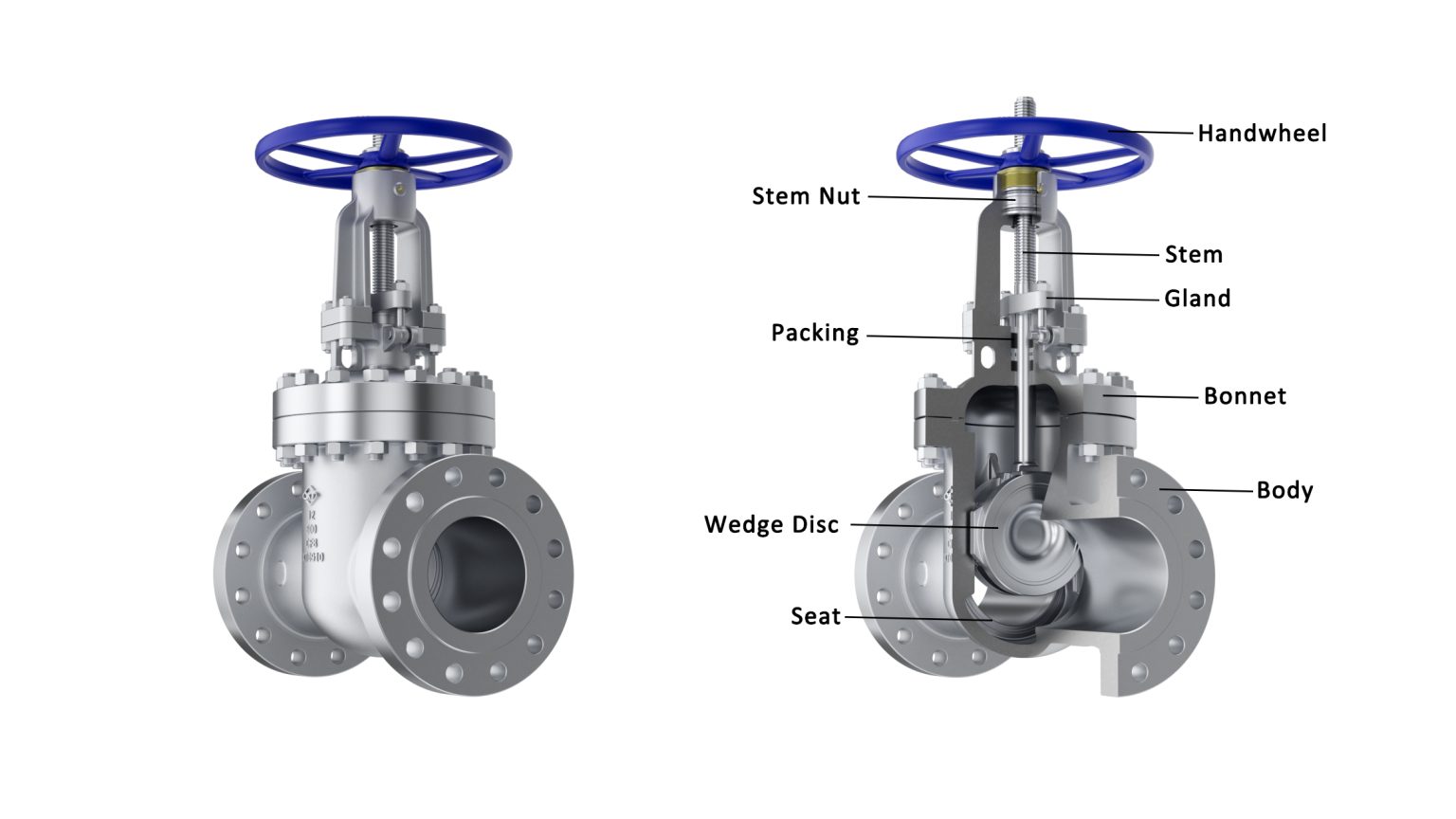
1. Working Principle and Construction Features
1.1 Working Principle
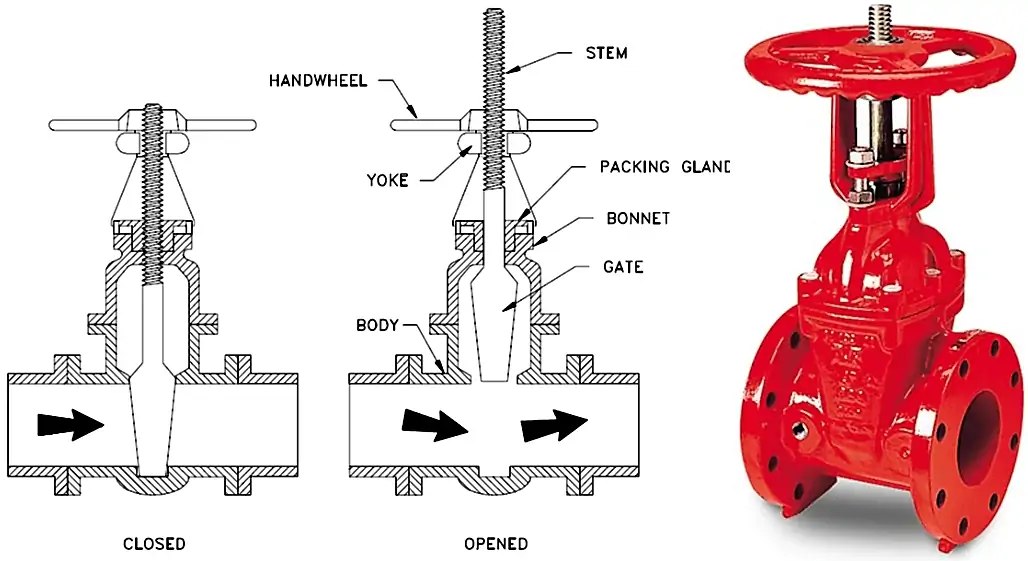
The gate valve is operated by rotating the handwheel or actuator to drive the stem, causing the gate to move vertically along the seat guides. When the gate is fully raised, the valve is fully open with an unobstructed flow path; when fully lowered, the valve is closed, stopping fluid flow.
The closing member is the gate, which moves perpendicular to the flow direction. The gate has two sealing surfaces that mate with the seats to achieve sealing.
1.2 Gate Valve Classification
Gate valves can be classified by gate construction, stem type and connection method:
By gate construction:
| Type | Characteristics | Applications |
|---|---|---|
| Wedge Gate Valve | Wedge-shaped gate; sealing surfaces form a wedge angle; self‑wedging action improves sealing when closed | Medium-high pressure, high temperature – most common type |
| Parallel Gate Valve | Flat gate with two parallel sealing surfaces | Low pressure, large diameter – suitable for water systems |
| Knife Gate Valve | Blade‑type gate capable of cutting through solids‑laden media | Slurries, wastewater treatment, pulp & paper |
By stem construction:
| Type | Characteristics | Applications |
|---|---|---|
| Rising Stem | Stem rises and falls with the gate – opening position visually indicated | Most industrial applications – convenient for visual position indication |
| Non‑rising Stem | Stem rotates without rising – valve height remains constant | Space‑constrained installations |
2. Major Application Scenarios
| Application Sector | Typical Conditions | Recommended Gate Valve Type |
|---|---|---|
| Petrochemical | Crude oil, refined products, chemical feedstocks | Wedge gate valve, rising stem, cast/forged body |
| Power Generation | High‑temperature steam, feedwater systems | Wedge gate valve, special high‑temperature materials |
| Water Treatment | Municipal water supply, wastewater treatment | Parallel gate valve or knife gate valve |
| Natural Gas | High‑pressure gas transmission | Wedge gate valve, fire‑safe design |
| Metallurgy | Cooling water, flue gas | Knife gate valve, wear‑resistant design |
3. Key Gate Valve Selection Parameters
3.1 Pressure Rating
Gate valve pressure rating should be selected based on the system's maximum operating pressure with appropriate safety margin to ensure reliable operation under the most severe conditions.
| Pressure Rating (Class) | Corresponding PN | Typical Applications |
|---|---|---|
| Class 150 | PN 20 | Low‑pressure water, air systems |
| Class 300 | PN 50 | Medium‑pressure steam, chemical systems |
| Class 600 | PN 100 | High‑pressure pipelines, refinery units |
| Class 900 | PN 150 | Ultra‑high‑pressure steam, petroleum |
| Class 1500 | PN 260 | High‑temperature, high‑pressure petrochemical |
3.2 Size and Flow Capacity
Gate valve size selection must consider both pipe size compatibility and flow requirements. Gate valves have very low flow resistance when fully open, with Cv values typically higher than globe valves of the same size. The required Cv value can be calculated from the system's maximum required flow rate to determine the appropriate valve size.
3.3 Temperature and Materials
Temperature is a critical factor in gate valve selection. High temperatures reduce material strength ratings; therefore, the coupled pressure‑temperature relationship must be considered.
| Temperature Range | Recommended Body Material | Recommended Seat/Seal Material |
|---|---|---|
| -29°C ~ 200°C | Carbon steel (WCB) | PTFE, flexible graphite |
| 200°C ~ 450°C | Cr‑Mo steel (WC6/WC9) | Flexible graphite, metal‑seated |
| 450°C ~ 650°C | Stainless steel (CF8C) | Metal‑seated, hard‑faced |
| Cryogenic (-196°C) | Stainless steel (CF8M) | Special low‑temperature materials |
3.4 Media Compatibility
Body and seal materials must be chemically compatible with the system media. The following table provides material recommendations for common media:
| Media Type | Recommended Body Material | Recommended Seat/Seal Material |
|---|---|---|
| Water, steam, oil | Carbon steel | PTFE, flexible graphite |
| Acids, alkalis, corrosive chemicals | Stainless steel 316L | PTFE, PEEK |
| Natural gas, hydrogen | Carbon steel/stainless steel | PTFE, flexible graphite |
| Slurries, particulate media | Stainless steel/wear‑resistant alloys | Ceramic‑seated |
4. Comparison with Other Valve Types
| Comparison Aspect | Gate Valve | Globe Valve | Ball Valve | Butterfly Valve |
|---|---|---|---|---|
| Operation | Linear lift | Linear lift | Quarter‑turn | Quarter‑turn |
| Flow resistance | Very low (fully open) | High | Very low | Low |
| Sealing performance | Good | Excellent | Excellent | Good |
| Throttling capability | Poor (not recommended) | Excellent | Poor | Good |
| Operating speed | Slow | Slow | Fast | Fast |
| Suitable size range | All sizes | DN≤300 | All sizes | DN≥50 |
| Cost | Medium | Medium | Higher | Lower |
5. Common Gate Valve Selection Mistakes
| Mistake | Correct Understanding |
|---|---|
| Gate valves can be used for flow regulation | Gate valves are designed for full open or full closed only. In partially open positions, gate vibration and seat erosion intensify, potentially damaging the valve |
| Non‑rising stem valves are inferior to rising stem | Each has advantages. Non‑rising stem suits space‑constrained installations; rising stem allows visual position indication |
| All gate valves are bi‑directional | Most gate valves are bi‑directional, but some designs (e.g., wedge gate valves) have preferred flow direction – check arrow markings during installation |
| Parallel gate valves suit all conditions | Parallel gate valves are typically suitable only for low‑pressure applications – high‑pressure applications should use wedge gate valves |
6. Applicable Standards
| Standard | Content | Applicable Scope |
|---|---|---|
| API 600 | Steel gate valves for petroleum and natural gas | Petrochemical |
| API 602 | Compact steel gate valves | Refining, chemical |
| ASME B16.34 | Valve pressure‑temperature ratings | General |
| MSS SP‑70 | Cast iron gate valves | General industrial |
| ISO 10434 | Gate valves for petroleum and natural gas industries | Oil & gas |
7. Installation and Maintenance Points
7.1 Installation Recommendations
Flow direction: Verify flow direction markings before installation and install per arrow direction
Vertical installation: Gate valves should be installed as vertically as possible, with handwheel facing upward (for easier operation and sealing)
Support: Large‑diameter gate valves should have independent supports at both ends to prevent the body from bearing pipe weight
Full open or full closed: Gate valves should always be operated to fully open or fully closed positions – partial opening is not permitted
7.2 Maintenance Recommendations
Periodic operation: Gate valves not operated for extended periods should be cycled quarterly to prevent stem seizure
Seal inspection: Regularly inspect stem packing area for leakage
Lubrication: Stem threads on rising stem gate valves should be lubricated regularly
Seat inspection: When internal leakage is detected, inspect seat sealing surfaces for wear or debris


