


Check Valve Selection Guide: Swing vs. Lift vs. Spring – Types, Applications, and Installation Best Practices
Check valves are the unsung heroes of industrial piping systems. Unlike gate, globe, or ball valves, check valves require no manual or external actuation—they operate automatically in response to fluid flow. Their sole purpose is to prevent backflow, protecting pumps, compressors, and other equipment from reverse flow damage.
Check valves are found in virtually every industrial fluid system: pump discharge lines, compressor stations, steam systems, water treatment plants, and chemical processing facilities. Yet despite their ubiquity, they are among the most frequently misapplied valves. Incorrect check valve selection is a leading cause of pump damage, water hammer, and system downtime.
This guide provides engineers with a comprehensive framework for selecting the right check valve for their application, covering the three main types—swing, lift, and spring—along with key selection parameters, installation best practices, and common pitfalls to avoid.
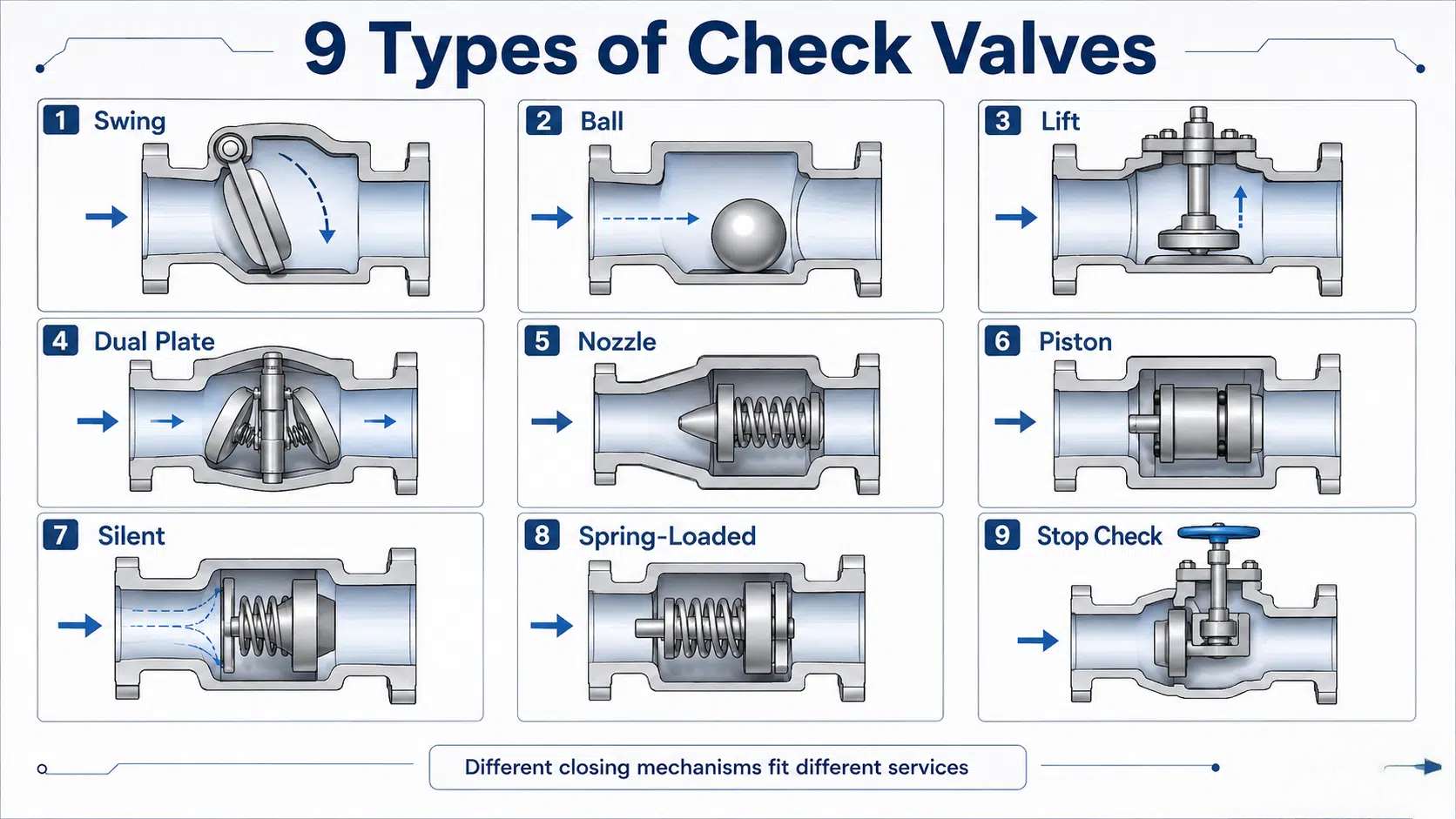
1. How Check Valves Work
A check valve allows flow in one direction and automatically prevents flow in the reverse direction. The valve opens when the upstream pressure exceeds the downstream pressure by a certain amount—known as the cracking pressure—and closes when the downstream pressure exceeds the upstream pressure or when forward flow stops.
Key operating principle:
Opening: Forward flow pressure overcomes the disc/ball weight and/or spring force
Closing: Backflow, gravity, or spring force returns the disc/ball to the seat
Cracking pressure: The minimum upstream pressure required to initiate opening
1.1 Critical Design Considerations
| Consideration | Why It Matters |
|---|---|
| Cracking pressure | Must be low enough to open at normal flow, high enough to prevent flutter |
| Closure speed | Too slow → slam and water hammer; too fast → shock loading |
| Pressure drop | All check valves create some pressure drop; swing type is lowest, lift/spring are higher |
| Orientation | Some types are position‑sensitive (horizontal vs. vertical installation) |
2. Main Types of Check Valves
2.1 Swing Check Valve
Working principle: A disc hinged at the top swings open when flow pushes it forward and swings closed when flow stops or reverses, seating against the valve body.
| Characteristic | Details |
|---|---|
| Disc movement | Pivots on a hinge pin (like a door) |
| Cracking pressure | Very low (weight of disc) |
| Pressure drop | Lowest of all check valve types |
| Preferred orientation | Horizontal (disc swings upward) |
| Applications | Water, wastewater, oil, gas, steam (≤400°C) |
| Size range | DN50 – DN1200+ |
| Sealing | Metal‑to‑metal or soft‑seated |
Advantages:
Low pressure drop
Simple, durable construction
Suitable for large diameters
Low cost relative to other types
Limitations:
Slow closure (prone to slam and water hammer)
Not suitable for pulsating flow
Requires horizontal installation (or vertical with upward flow)
Larger footprint than other types
Best applications:
Pump discharge lines (where water hammer is not severe)
Gravity flow systems
Large‑diameter water and wastewater lines
Systems with steady, non‑pulsating flow
2.2 Lift Check Valve
Working principle: A disc or piston moves vertically (lifted) within a guide cage. Forward flow lifts the disc off the seat; backflow forces it back down.
| Characteristic | Details |
|---|---|
| Disc movement | Vertical linear motion |
| Cracking pressure | Moderate (disc weight + seat friction) |
| Pressure drop | Higher than swing type |
| Preferred orientation | Horizontal (or vertical with upward flow) |
| Applications | High‑pressure steam, gas, high‑velocity fluids |
| Size range | DN15 – DN200 |
| Sealing | Better than swing (guided disc) |
Advantages:
Better sealing than swing check
Suitable for high pressure and temperature
Compact design (smaller footprint)
Available in angle pattern (90° turn)
Limitations:
Higher pressure drop than swing type
Not suitable for slurries or dirty fluids (guide cage can clog)
Requires precise alignment (vertical guide)
Limited to smaller diameters
Best applications:
High‑pressure steam systems
Gas compressor discharge
High‑velocity fluid services
Clean fluids (no solids)
Sub‑type – Angle lift check:
Combines a lift check with a 90° piping turn. Ideal for applications requiring a direction change while preventing backflow, saving one fitting.
2.3 Spring‑Loaded Check Valve
Working principle: A spring holds the disc against the seat until forward flow pressure exceeds the spring force, lifting the disc. When forward flow stops, the spring quickly returns the disc to the seat.
| Characteristic | Details |
|---|---|
| Disc movement | Vertical linear motion (spring‑assisted) |
| Cracking pressure | Spring‑determined (0.1 – 10 bar) |
| Pressure drop | Moderate (similar to lift check) |
| Preferred orientation | Any orientation |
| Applications | Pulsating flow, high‑cycle applications, vertical lines |
| Size range | DN8 – DN250 |
| Sealing | Excellent (soft or metal seat) |
Advantages:
Any orientation (spring provides closure)
Fast closure – excellent for pulsating flow
Good sealing (soft seat available)
Compact and lightweight
Limitations:
Higher pressure drop than swing type
Spring fatigue over time (requires maintenance)
Not suitable for high‑temperature (spring loses strength)
Higher cost than swing type
Best applications:
Pump discharge with pulsating flow
Vertical pipelines (any direction)
High‑cycle applications
Process systems requiring positive shut‑off
3. Comparison of Check Valve Types
| Feature | Swing Check | Lift Check | Spring‑Loaded |
|---|---|---|---|
| Disc movement | Hinged pivot | Vertical lift | Vertical lift + spring |
| Cracking pressure | Lowest | Moderate | Adjustable |
| Pressure drop | Lowest | Higher | Moderate‑High |
| Closure speed | Slow (slam risk) | Fast | Fastest |
| Orientation | Horizontal only | Horizontal/vertical | Any |
| Pulsating flow | Poor | Moderate | Excellent |
| Slurry/solids | Good | Poor | Poor |
| Size range | DN50 – DN1200+ | DN15 – DN200 | DN8 – DN250 |
| Maintenance | Simple | Moderate | Moderate |
| Cost | Low | Moderate | Moderate‑High |
4. Check Valve Installation Best Practices
4.1 Orientation Requirements
| Valve Type | Permitted Orientation | Notes |
|---|---|---|
| Swing check | Horizontal only | Disc must swing upward; vertical installation causes disc to rest on seat, affecting cracking pressure |
| Lift check | Horizontal or vertical with upward flow | Disc must lift against gravity |
| Spring check | Any orientation | Spring provides positive closure in all orientations |
4.2 Key Installation Considerations
| Consideration | Best Practice |
|---|---|
| Location | Install at least 5–10 pipe diameters downstream of pumps, elbows, tees, or other turbulence‑generating fittings to ensure stable flow and proper closure |
| Pump discharge | Never install directly at pump outlet—allow straight run for flow stabilisation |
| Arrow direction | Always install with flow arrow pointing downstream |
| Accessibility | Install in accessible location for inspection and maintenance |
| Pipe support | Provide independent support, especially for large‑diameter valves |
| Cavitation risk | Install in location where downstream pressure is sufficiently high to prevent flashing |
4.3 Avoiding Water Hammer
Water hammer is the most common problem associated with check valves—caused by sudden disc closure when flow reverses.
Solutions:
Use spring‑loaded or silent check valves for fast closure
Install dashpot‑equipped or controlled‑closure swing checks
Avoid sizing the check valve too large (oversizing leads to disc flutter and premature closure)
Select valves with leak‑tight sealing to minimise reverse flow shock
5. Water Hammer, Chattering, and Sizing
5.1 Water Hammer
| Condition | Cause | Solution |
|---|---|---|
| Check valve slams | Disc not closed before flow reversal | Use spring‑assisted or silent check valve |
| Piping vibration | Rapid pressure fluctuations | Add pulsation dampener or stabilise flow |
| System pressure spikes | Sudden valve closure | Use non‑slamming check valve design |
5.2 Disc Chattering
Chattering occurs when the disc continuously opens and closes, typically caused by pulsating flow or improperly sized valves. This causes rapid wear of the disc and seat.
| Cause | Solution |
|---|---|
| Valve oversized for normal flow | Size based on normal (not peak) flow; operate within recommended Cv range |
| Pulsating flow from pumps | Install pulsation dampener or use spring‑assisted check valve |
| Low flow below cracking pressure | Consider spring‑assisted type with lower cracking pressure |
| Transient flow conditions | Select valve with damping mechanism |
5.3 Sizing Guidelines
The most common mistake is oversizing the check valve. A valve that is too large will:
Operate with the disc partially open (fluttering)
Fail to close properly
Experience accelerated wear
Increase maintenance costs
Sizing principle: Select a valve size that ensures the disc is fully open at the expected normal flow rate, not just at peak conditions. Work with Cv curves provided by the manufacturer.
5.4 Flow Characteristics
Check valves are velocity‑dependent devices. The following parameters should be considered:
| Parameter | Importance |
|---|---|
| Minimum flow velocity | Must be sufficient to fully open the disc (typically ≥1.0 m/s for swing, ≥1.5 m/s for lift) |
| Maximum flow velocity | Must not exceed manufacturer's limit (typically ≤6 m/s) |
| Flow velocity variation | Wide variation may require spring‑assisted type |
| Flow direction changes | Multiple changes create turbulence affecting disc stability |
6. Media Compatibility and Special Applications
| Application | Recommended Check Valve | Key Consideration |
|---|---|---|
| Water/wastewater | Swing check (large lines), spring check (small lines) | Low pressure drop, corrosion resistance |
| Steam (high pressure) | Lift check (clean steam), swing check (saturated) | High temperature, tight sealing |
| Pulp/paper, slurry | Swing check (or specially designed) | Solids passage, avoid lift/spring types |
| Chemical processing | Spring check (PTFE seat), lift check | Chemical compatibility of all wetted parts |
| Food/beverage | Sanitary spring check (tri‑clamp) | FDA‑compliant seals, cleanability |
| Corrosive fluids | Spring check (PVC/CPVC, Hastelloy) | Material selection critical |
| High‑pressure gas | Lift check (clean, dry gas) | Leak‑tight sealing, high pressure rating |
| Pump discharge (pulsating) | Spring check | Fast closure, any orientation |
7. Common Check Valve Selection Mistakes
| Mistake | Correct Practice |
|---|---|
| Using swing check in vertical pipe | Swing checks require horizontal orientation—use spring check for vertical lines |
| Oversizing the valve | Size based on normal flow to ensure full disc opening; consult Cv curves |
| Ignoring pulsating flow | Use spring‑assisted check valves for reciprocating pump discharge |
| Placing too close to pump | Install check valve at least 5–10 pipe diameters downstream of pump to avoid turbulence and allow flow stabilisation |
| Using lift check in dirty service | Lift checks have close‑clearance guides that trap solids—use swing check for dirty fluids |
| Ignoring spring fatigue | In spring checks, inspect and replace springs periodically, especially in high‑temperature or high‑cycle applications |
| Selecting by price alone | Different types are designed for specific conditions—choose based on performance and reliability, not just initial cost |
8. Standards and Specifications
| Standard | Scope |
|---|---|
| API 594 | Check valves (wafer, lug, double flange) |
| API 6D | Pipeline check valves (swing, tilting disc) |
| ASME B16.34 | Pressure‑temperature ratings |
| BS 1868 | Steel check valves (flanged and wafer) |
| MSS SP‑80 | Bronze check valves |
| MSS SP‑88 | Diaphragm‑type check valves |
| API 598 | Valve inspection and testing |
9. Quick Selection Guide
| Your Condition | Recommended Check Valve |
|---|---|
| Large diameter (DN ≥ 300) | Swing check |
| High‑pressure steam (>400°C) | Lift check (clean steam) |
| Pulsating flow | Spring check |
| Vertical installation | Spring check |
| Minimal pressure drop | Swing check |
| Tight shut‑off required | Spring check (soft seat) |
| Dirty/slurry service | Swing check (heavy‑duty) |
| Small diameter (DN ≤ 50) | Spring check or lift check |
10. Series Navigation
← Previous article: [Globe Valve Selection Guide: Z‑Body vs. Y‑Body vs. Angle Pattern – Types, Pressure Ratings, and Sizing]
→ Next article: Ball Valve Selection Guide: Floating vs. Trunnion – Full Port vs. Reduced Port – Fire‑Safe Design


