


Ball Valve Selection Guide: Floating vs. Trunnion – Full Port vs. Reduced Port – Fire-Safe Design
Ball valves are among the most widely used industrial valves, prized for their quarter-turn operation, low pressure drop, and reliable sealing. Unlike gate or globe valves that require multiple turns to open or close, ball valves achieve full flow or shut-off with a simple 90° rotation. This makes them ideal for applications requiring rapid isolation.
However, the term "ball valve" encompasses a broad family of designs. Selection requires understanding three key dimensions: structural type (floating vs. trunnion-mounted), port design (full port vs. reduced port), and seat material (soft vs. metal-seated). This guide provides engineers with a comprehensive framework for selecting the right ball valve for their application.
1. How Ball Valves Work
A ball valve uses a spherical ball with a bore (hole) drilled through its centre. Rotating the ball 90° aligns the bore with the pipeline for flow or blocks it for shut-off.
Key operating principle: The ball rotates between two cup-shaped seals called seats. When closed, the ball presses against the downstream seat (floating design) or the seats press against the ball (trunnion design) to create a seal.
Advantages of ball valves:
Fast operation (quarter-turn)
Very low pressure drop when fully open
Excellent shut-off capability (bubble-tight in soft-seated designs)
Suitable for a wide range of pressures and temperatures
2. Structural Types: Floating vs. Trunnion-Mounted
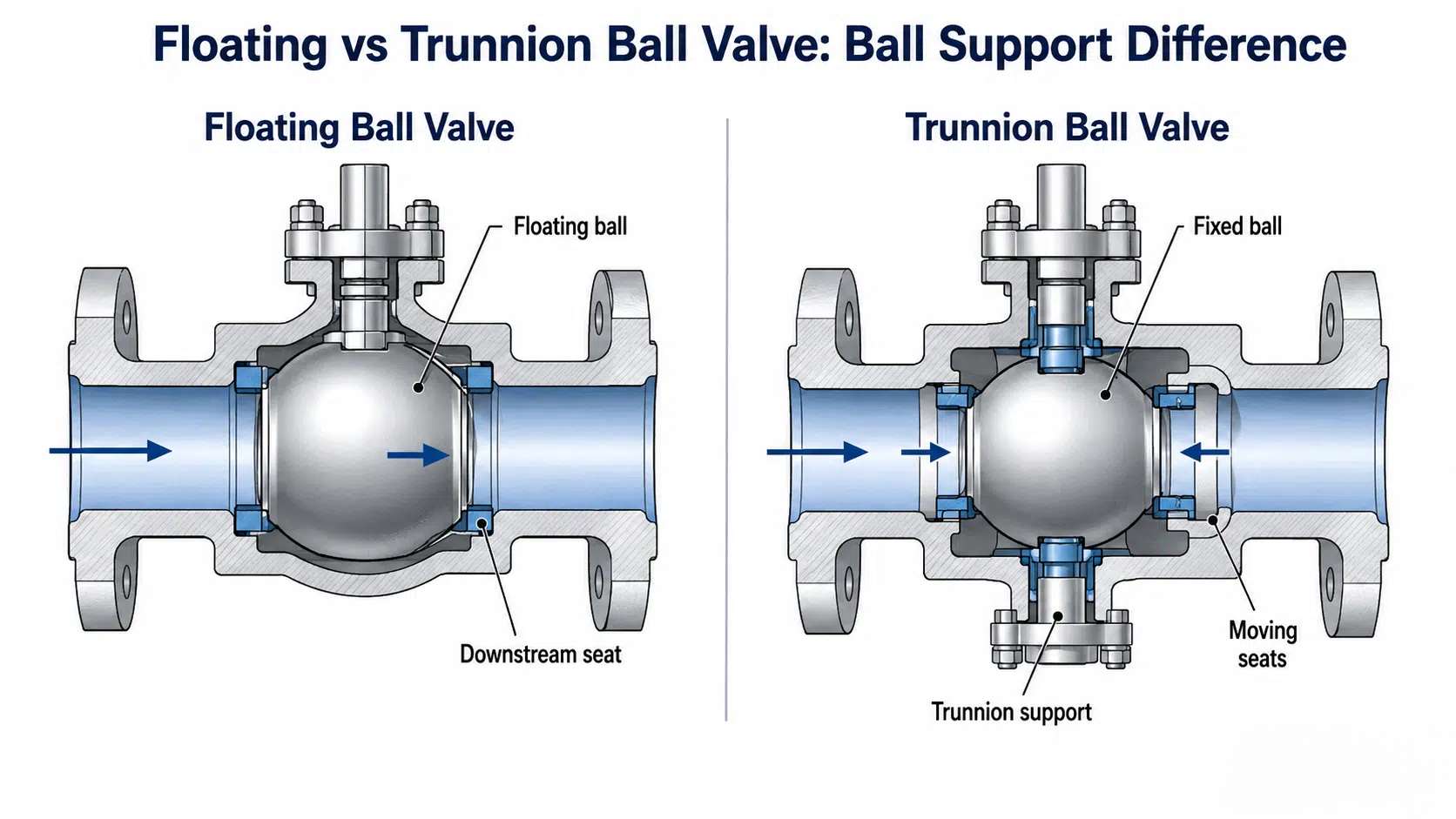
The most fundamental distinction in ball valve design is how the ball is supported .
2.1 Floating Ball Valve
Working principle: The ball is not mechanically fixed; it "floats" between two seats. When closed, line pressure pushes the ball downstream against the seat, creating the seal. This is known as pressure-assisted sealing.
Advantages:
Simpler, more economical design
Excellent sealing at low-to-moderate pressures
Compact and lightweight
Limitations:
Operating torque rises sharply with pressure (at high pressure, torque can increase by 300–400%)
Not suitable for large diameters or high pressures
Seat wear accelerates under high-pressure cycling
Best applications:
Small-bore piping (½"–8")
General industrial isolation
Instrument root valves
Utility services where cost is the primary driver
2.2 Trunnion-Mounted Ball Valve
Working principle: The ball is mechanically anchored at the top and bottom by trunnion bearings. The ball rotates but does not move laterally. Instead of the ball moving to the seat, the seats are spring-loaded and move toward the ball to create the seal. Sealing force is largely independent of line pressure .
Advantages:
Low, consistent operating torque regardless of pressure
Suitable for large diameters and high pressures
Reduced seat wear—trunnion absorbs pressure load
Double Block & Bleed (DBB) capability for higher safety
Often allows online seat maintenance (reduces downtime by 60–80%)
Limitations:
Higher initial cost (2–4× floating type)
More complex design
Requires cavity pressure relief (self-relieving seat or external valve)
Heavier and larger footprint
Best applications:
Large-bore pipelines (≥8")
High-pressure systems (Class 600+)
Critical services in oil & gas, petrochemicals, power plants
Automated systems requiring low torque
Applications requiring DBB capability
Subsea and pipeline isolation (API 6D)
2.3 Floating vs. Trunnion: Quick Comparison
| Parameter | Floating Ball | Trunnion Ball |
|---|---|---|
| Ball support | Free-floating | Fixed by bearings |
| Sealing principle | Ball pressed against seat by pressure | Seats spring-loaded against fixed ball |
| Torque vs. pressure | Increases with pressure | Low and constant |
| Size limit | ≤8"–10" | 4"–60"+ |
| Pressure class | Class 150–600 | Class 150–2500 |
| DBB capability | No | Yes |
| Cavity pressure relief | Not required | Required |
| Cost (6", Class 150) | Baseline | 2–4× higher |
| Standards | API 608 | API 6D, API 608 |
Decision threshold: The critical boundary between floating and trunnion designs is approximately 8" at Class 300. Above this, floating valves become impractical due to excessive torque and seat stress .
3. Port Design: Full Port vs. Reduced Port
The bore through the ball can be designed in two ways .
3.1 Full Port (Full Bore)
Design: The ball bore diameter matches the pipe inner diameter, providing an unobstructed flow path.
| Aspect | Detail |
|---|---|
| Flow resistance | Minimal (same as pipe) |
| Pigging capability | Yes—allows pipeline cleaning pigs to pass |
| Pressure drop | Lowest |
| Cost | Higher than reduced port |
| Applications | Pipeline transmission, piggable systems, high-flow services |
3.2 Reduced Port (Standard Port)
Design: The ball bore diameter is smaller than the pipe inner diameter, creating a flow restriction.
| Aspect | Detail |
|---|---|
| Flow resistance | Moderate (may reduce flow rate depending on system) |
| Pigging capability | No |
| Pressure drop | Higher than full port |
| Cost | Lower than full port |
| Applications | General industrial, throttling (limited), lower-cost alternatives |
3.3 V-Port Ball
Design: The ball features a V-shaped notch that provides precise flow control when the ball is rotated—offering better throttling capability than standard ball valves.
Best for: Applications requiring modulation and control, especially with slurries and fibrous media (the V-notch shears through solids).
4. Seat Materials: Soft Seat vs. Metal Seat
The seat is the sealing surface between the ball and the body. Material choice depends on temperature, pressure, media, and leakage requirements .
4.1 Soft Seat
Materials: PTFE, RPTFE (Reinforced PTFE), Nylon, PEEK.
| Characteristic | Detail |
|---|---|
| Leakage | Bubble-tight (zero leakage per API 598) |
| Temperature | PTFE: up to 232°C (450°F); PEEK: up to 300°C+ |
| Pressure | Up to Class 6000 (PEEK) |
| Abrasion resistance | Poor—not suitable for slurries or dirty media |
| Cost | Lower |
| FDA compliance | PTFE and some grades are FDA-compliant |
Applications: Clean fluids, water, gases, chemicals, food processing, pharmaceuticals.
Limitations: Soft materials degrade above temperature limits; abrasives scratch the seat, causing immediate leakage.
4.2 Metal Seat
Materials: Stainless steel base with Tungsten Carbide Coating (TCC), Chrome Carbide (CCC), or Stellite overlay .
| Characteristic | Detail |
|---|---|
| Leakage | Class V or VI (allowable slight leakage) |
| Temperature | Up to 500°C+ (1000°F+) |
| Abrasion resistance | Excellent (hardness up to 70 HRC) |
| Cost | Higher |
| Applications | High temperature, abrasive media, slurries, steam |
Applications: High-temperature processes, slurries, dirty media, abrasive fluids, steam.
Limitations: Higher cost; not bubble-tight (though modern precision machining is closing the gap) .
4.3 Selection Matrix: Seat Material
| Condition | Recommended Seat | Reason |
|---|---|---|
| Clean fluids, moderate temperature | Soft (PTFE/RPTFE) | Bubble-tight seal, cost-effective |
| High temperature (>260°C) | Metal | Soft materials melt or deform |
| Abrasive/slurry media | Metal (TCC/Stellite) | Soft seats destroyed by abrasion |
| Cryogenic (LNG) | Soft (PCTFE) + extended bonnet | Prevents brittle fracture; keeps packing in gas phase |
| High purity/sanitary | Soft (PTFE, FDA-compliant) | Non-contaminating, cleanable |
5. Fire-Safe Design
For applications with flammable or hazardous fluids, fire-safe design is essential. Fire-safe ball valves are designed to maintain sealing integrity during and after a fire.
Key features:
Anti-static devices: Prevent spark accumulation from static charge
Fire-safe seats: Primary soft seats melt away, allowing secondary metal-to-metal seal to engage
Spill-proof stems: Prevent leakage through stem in case of fire
Applicable standards: API 607, API 6FA.
When required:
Flammable liquids and gases
Refineries and petrochemical plants
Offshore and subsea installations
Natural gas transmission
6. Actuation and Control
Ball valves are available with manual or automated actuation .
| Actuation Type | Advantages | Limitations | Best For |
|---|---|---|---|
| Manual (lever) | Lowest cost, simple, reliable | Not for inaccessible locations, frequent cycling | Infrequent operation, small sizes |
| Manual (gear) | Reduces operating torque | Slower operation | Large diameter, high torque |
| Pneumatic | Fast operation (0.5–1 sec), high torque | Requires compressed air | Automated systems with air supply |
| Electric | No air supply needed, precise control | Slower (6+ seconds), higher initial cost | Remote locations, modulating control |
| Hydraulic | Very high force/speed | Requires hydraulic power | Heavy-duty applications |
Actuator sizing note: For floating ball valves, operating torque increases significantly with pressure—ensure actuator sizing accounts for maximum line pressure. Trunnion valves maintain consistent torque regardless of pressure, often allowing 30–50% smaller actuators .
7. Ball Valve Application Matrix
| Application | Recommended Structure | Recommended Seat | Reason |
|---|---|---|---|
| Small pipe (≤6"), clean fluid | Floating | Soft (PTFE/RPTFE) | Most cost-effective; excellent sealing |
| High pressure / large bore | Trunnion | Soft or Metal | Reduces torque; prevents ball seizing |
| Slurry, dirty, scaling | Trunnion | Metal (TCC/Stellite) | Soft seats destroyed by abrasion |
| High temperature (>260°C) | Floating or Trunnion | Metal | Soft materials melt or deform |
| LNG / Cryogenic | Trunnion | Soft (PCTFE) | Extended bonnet required; prevents brittle fracture |
| Fire-safe required | Trunnion | Metal with fire-safe design | API 607 / API 6FA compliant |
| Sanitary / pharmaceutical | Floating | Soft (PTFE, FDA) | Cleanable, FDA-compliant |
| Pipeline pigging | Trunnion | Soft or Metal | Full port required; DBB capability |
8. Common Selection Mistakes
9. Standards and Specifications
| Standard | Scope |
|---|---|
| API 6D | Pipeline ball valves (trunnion) |
| API 608 | Metal ball valves (floating) |
| ASME B16.34 | Pressure-temperature ratings |
| API 598 | Valve inspection and testing |
| ISO 17292 | Metal ball valves for petroleum, petrochemical, and allied industries |
| API 607 / API 6FA | Fire-safe testing |
10. Series Navigation
← Previous article: Check Valve Selection Guide: Swing vs. Lift vs. Spring – Types, Applications, and Installation Best Practices
→ Next article: Plug Valve Selection Guide: Lubricated vs. Non-Lubricated – Multi-Port Applications


