


Plug Valve Selection Guide: Lubricated vs. Non-Lubricated – Multi-Port Applications
Plug valves are among the oldest valve designs, with a history dating back to ancient Roman times. Today, they remain indispensable in industrial fluid systems. Their core design is extremely simple—a tapered or cylindrical plug with a flow passage rotates 90° or 180° within the valve body to start, stop, or divert flow.
The unique advantage of plug valves lies in their multi-port capability—three-way and four-way plug valves can simultaneously achieve flow diversion, distribution, and mixing—functions that are difficult or impossible for ball, gate, or globe valves. This guide provides engineers with a comprehensive selection framework covering plug valve types, selection parameters, lubrication systems, multi-port applications, and common mistakes.
1. Working Principle and Construction Features
1.1 Working Principle
The core of a plug valve is a tapered or cylindrical plug with a flow passage, mounted within the valve body. Rotating the plug aligns the passage with the pipeline (open) or perpendicular to it (closed).
Key operating principles:
Open: Plug rotated, passage aligns with the pipeline—flow passes freely
Closed: Plug rotated 90°, passage perpendicular to the pipeline—flow is blocked
Diversion: Multi-port plug valves can switch flow direction, divert, or mix
1.2 Plug Valve Classification
| Classification | Type | Characteristics |
|---|---|---|
| By lubrication | Lubricated | Sealant injection achieves sealing; suitable for high pressure |
| Non-lubricated | PTFE sleeve or lining provides sealing; maintenance-free | |
| By plug shape | Tapered plug | Traditional design; conical sealing surface |
| Cylindrical plug | Modern design; higher machining precision | |
| By port count | Two-way | Simple on/off |
| Three-way | Divert, distribute, mix | |
| Four-way | Complex flow switching |
1.3 Unique Advantages of Plug Valves
Multi-port function: Three-way/four-way designs enable simultaneous flow diversion and distribution
Fast operation: 90° rotation—as fast as ball valves
Low pressure drop: Straight-through flow path, minimal flow resistance
Wear resistance: Suitable for slurries and particle-containing media
Simple construction: Fewer parts, high reliability
2. Lubricated vs. Non-Lubricated Plug Valves
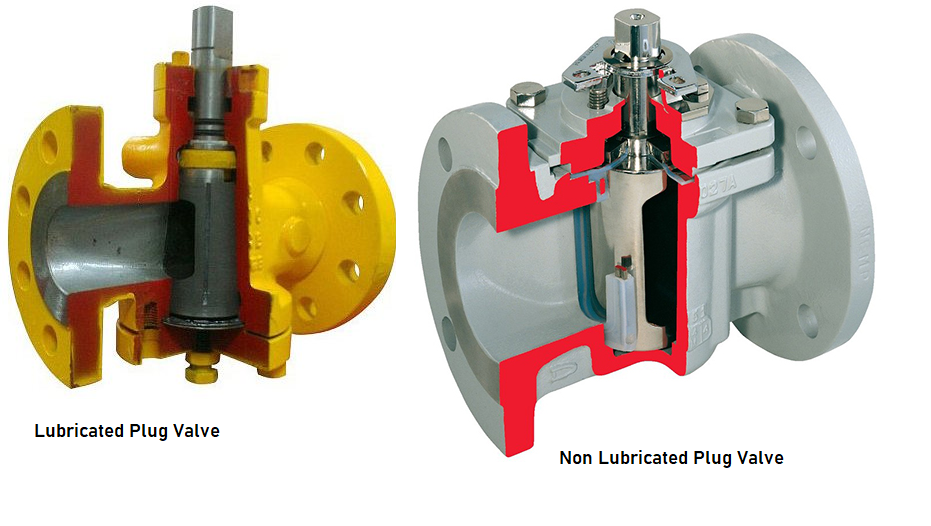
2.1 Lubricated Plug Valve
Working principle: A sealant is injected through the valve body into the gap between the plug and body, forming a lubricating film that reduces operating torque and provides sealing.
| Characteristic | Details |
|---|---|
| Sealing mechanism | Sealant film on plug surface |
| Operating torque | Low (when well-lubricated) |
| Pressure rating | Up to Class 2500 |
| Temperature range | Limited by sealant (typically ≤200°C) |
| Maintenance | Requires periodic sealant injection |
| Cost | Medium-high |
| Suitable media | Oil, gas, water, hydrocarbons |
Advantages:
Good sealing performance, suitable for high pressure
Low operating torque
Sealant flushes impurities from seat surfaces
Limitations:
Requires periodic sealant injection (increases maintenance cost)
Sealant may be incompatible with certain media (e.g., food, pharmaceutical)
Not suitable for high temperatures (sealant decomposes)
Best applications:
High-pressure oil and gas pipelines
Refineries
Natural gas transmission
Hydrocarbon media
2.2 Non-Lubricated Plug Valve
Working principle: The plug surface is covered with a PTFE sleeve or lining, using PTFE's self-lubricating properties and elasticity to achieve sealing. No sealant injection is required.
| Characteristic | Details |
|---|---|
| Sealing mechanism | Elastic deformation of PTFE sleeve/liner |
| Operating torque | Medium (higher initially, stabilizes over time) |
| Pressure rating | Up to Class 600 |
| Temperature range | PTFE: up to 232°C; PFA: up to 260°C |
| Maintenance | Maintenance-free (long sleeve life) |
| Cost | Medium |
| Suitable media | Water, gases, chemicals, corrosive fluids |
Advantages:
No sealant injection—maintenance-free
Suitable for clean applications such as food and pharmaceuticals
Reliable sealing, stable operating torque
Excellent corrosion resistance (PTFE lining)
Limitations:
Lower pressure rating than lubricated type
PTFE sleeve may creep at high temperatures
Not suitable for abrasive media (damages sleeve)
Best applications:
Water treatment
Food and beverage
Pharmaceuticals
Chemical processing
Low-pressure gases
3. Multi-Port Plug Valves
The multi-port capability of plug valves is their core advantage over other valve types.
3.1 Three-Way Plug Valves
| Port Configuration | Function | Typical Applications |
|---|---|---|
| L-Port | Switches between two lines (select one of two) | Sampling, bypass switching |
| T-Port | Three-way full opening, divert or mix | Mixing stations, distribution stations |
L-Port three-way plug valve: The plug has an "L"‑shaped passage that connects the inlet to one of two outlets, enabling flow switching.
T-Port three-way plug valve: The plug has a "T"‑shaped passage that connects the inlet to both outlets simultaneously, or any two ports, enabling flow distribution or mixing.
3.2 Four-Way Plug Valves
Four-way plug valves have two independent passages in the plug, enabling complex functions such as dual-in/dual-out or flow reversal.
| Configuration | Function | Typical Applications |
|---|---|---|
| Four-way divert | Two inlets ↔ Two outlets exchange | Filter switching, heat exchanger switching |
| Double block & bleed | Two independent isolation channels | Simultaneous control of two fluid streams |
3.3 Advantages of Multi-Port Valves
| Advantage | Description |
|---|---|
| Fewer valves | One multi-port valve replaces multiple two-way valves |
| Fewer connections | Reduced leak risk |
| Space saving | More compact piping |
| Simplified operation | One actuator controls multiple functions |
| Lower pressure drop | Shorter flow paths, fewer bends |
4. Plug Valve vs. Ball Valve
Plug valves and ball valves are often compared—both are quarter-turn valves with fast operation.
| Comparison Aspect | Plug Valve | Ball Valve |
|---|---|---|
| Sealing principle | Plug-to-body conical/cylindrical fit | Ball-to-seat point/line contact |
| Multi-port capability | Excellent (L/T/4-way) | Limited (2-way primary, 3-way available) |
| Particle media handling | Excellent (plug can shear particles) | Medium (particles may damage seats) |
| Operating torque | Medium-high | Lower |
| Sealing performance | Good-Excellent | Excellent |
| Maintenance | Lubricated: needs sealant; Non: maintenance-free | Seats replaceable |
| Cost | Medium-High | Medium |
| Standards | API 599, API 6D | API 608, API 6D |
Selection recommendations:
Need multi-port diversion → Plug valve
Particles or slurries → Plug valve (shearing action)
Need bubble-tight shut-off → Ball valve
High-pressure gas → Ball valve (better sealing)
5. Key Selection Parameters
5.1 Pressure and Temperature Ratings
| Pressure Rating | Lubricated | Non-Lubricated (PTFE sleeve) |
|---|---|---|
| Class 150 | ✅ Suitable | ✅ Suitable |
| Class 300 | ✅ Suitable | ✅ Suitable |
| Class 600 | ✅ Suitable | ⚠ Limited (confirm with manufacturer) |
| Class 900+ | ✅ Suitable | ❌ Not suitable |
Temperature limits:
Lubricated: ≤200°C (sealant-limited)
Non-lubricated (PTFE): ≤232°C
Non-lubricated (PFA): ≤260°C
5.2 Media Compatibility
| Media Type | Lubricated | Non-Lubricated (PTFE) | Recommendation |
|---|---|---|---|
| Clean water, gases | ✅ | ✅ | Either |
| Hydrocarbons, oils | ✅ | ✅ | Lubricated preferred |
| Corrosive chemicals | ❌ | ✅ | Non-lubricated |
| Slurries, particles | ✅ | ❌ (sleeve wear) | Lubricated |
| Food, pharmaceutical | ❌ (sealant contamination) | ✅ | Non-lubricated |
| High-pressure gas | ✅ | ⚠ | Lubricated |
5.3 Port Size
Similar to ball valves, plug valves are available in full port and reduced port designs:
| Port Type | Characteristics | Applications |
|---|---|---|
| Full port | Port matches pipe ID; piggable | Pipeline transmission, pigging systems |
| Reduced port | Port smaller than pipe ID | General industrial, cost-sensitive |
6. Lubricant Selection Guide (Lubricated Plug Valves)
The sealing and lubrication performance of lubricated plug valves depends directly on sealant quality.
| Condition | Recommended Lubricant | Characteristics |
|---|---|---|
| General oil, gas, water | Standard sealant | General-purpose, -20°C ~ 150°C |
| High temperature (>150°C) | High-temperature sealant | Contains graphite or MoS₂, up to 260°C |
| Low temperature (<-20°C) | Low-temperature sealant | Special formulation, down to -60°C |
| Corrosive media | Chemical-resistant sealant | Contains PTFE or special fillers |
| Food grade (non-contact) | NSF H1 certified lubricant | Safe for occasional food contact |
Important note: Lubricated plug valves require periodic sealant injection—frequency depends on operating frequency, temperature, and pressure. Prolonged lack of lubrication causes operating torque to rise sharply and sealing failure.
7. Installation and Maintenance Points
7.1 Installation Recommendations
Flow direction: Some plug valves have preferred flow direction—install per arrow markings
Flange alignment: Ensure flange faces are parallel to avoid additional stress
Support: Large-diameter plug valves require independent support
Stem upright: Facilitates maintenance and sealant injection
7.2 Maintenance Recommendations
Lubricated plug valves:
Inject sealant every 50–100 operations (or monthly)
Rotate plug slightly during injection to ensure even distribution
Check injection ports for leakage
If torque increases significantly, inject sealant immediately
Non-lubricated plug valves:
When operating torque increases, inspect PTFE sleeve for wear
PTFE sleeve life typically 2–5 years (depending on operating frequency)
Clean valve body thoroughly when replacing sleeve
General maintenance:
Valves not operated for extended periods should be cycled quarterly to prevent sticking
Check stem packing for leakage
Check plug for seizure
8. Common Selection Mistakes
| Mistake | Correct Practice |
|---|---|
| Using lubricated plug valves in food/pharma applications | Sealant may contaminate product—choose non-lubricated (PTFE sleeve) |
| Using non-lubricated plug valves in abrasive media | PTFE sleeve is worn by particles—choose lubricated (sealant protects) |
| Neglecting regular sealant injection (lubricated) | Establish injection schedule—lack of lubrication leads to high torque and seal failure |
| Selecting by price alone | Different designs for different conditions—total cost of ownership matters more |
| Using reduced port in high-cleanliness applications | Reduced port may trap media—choose full port |
9. Standards and Specifications
| Standard | Scope |
|---|---|
| API 599 | Metal plug valves (lubricated and non-lubricated) |
| API 6D | Pipeline plug valves |
| ASME B16.34 | Pressure-temperature ratings |
| MSS SP‑78 | Cast iron plug valves |
| MSS SP‑80 | Bronze plug valves |
| API 598 | Valve inspection and testing |
10. Series Navigation
← Previous article: Ball Valve Selection Guide: Floating vs. Trunnion – Full Port vs. Reduced Port – Fire-Safe Design
→ Next article: Diaphragm Valve Selection Guide: Weir vs. Straight-Through – Diaphragm Materials and Applications


