


Diaphragm Valve Selection Guide: Weir vs. Straight-Through – Diaphragm Materials and Applications
Diaphragm valves hold a unique position in the industrial valve family. Unlike other valves, they use the elastic deformation of a flexible diaphragm to shut off and regulate flow. The diaphragm completely isolates the fluid from the stem and actuator. This unique design makes them the preferred valve type for corrosive media, high-purity fluids, and aseptic processes.
Diaphragm valves are widely used in pharmaceutical, biotechnology, food and beverage, fine chemical, and water treatment industries. This guide provides engineers with a comprehensive selection framework covering working principles, construction types, diaphragm material selection, applications, and key selection criteria.
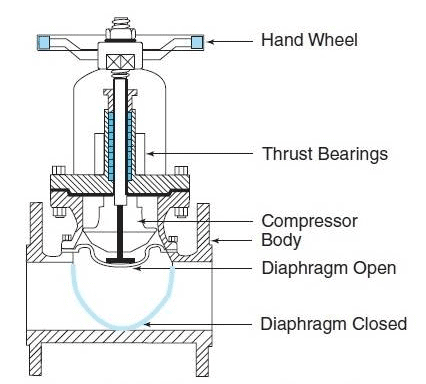
1. Working Principle and Construction Features
1.1 Working Principle
The core of a diaphragm valve is a flexible diaphragm, driven up and down by the stem. The diaphragm presses down against the weir seat on the valve body or directly against the body bottom to achieve sealing; lifting it opens the flow path.
Key operating principles:
Closed: Diaphragm pressed against weir or body bottom, cutting off flow
Open: Diaphragm lifted, fluid passes through
Throttling: Diaphragm partially open, achieving flow regulation
Isolation: Diaphragm completely isolates fluid from stem and actuator
1.2 Unique Advantages of Diaphragm Valves
| Advantage | Description |
|---|---|
| Dead-leg-free design | Fluid contacts only body and diaphragm – no grooves or cavities |
| Zero leakage | No dynamic seals (stem seal eliminated by diaphragm) – eliminates external leakage |
| No contamination | Fluid does not contact metal moving parts – no wear particles generated |
| Corrosion resistant | PTFE and other corrosion-resistant diaphragm materials available |
| Easy to clean | Suitable for CIP and SIP |
| Good throttling performance | Diaphragm lift enables precise flow control |
1.3 Weir-Type vs. Straight-Through
| Feature | Weir-Type | Straight-Through |
|---|---|---|
| Flow path | Raised weir seat in body | Flat body bottom, no weir |
| Flow resistance | Medium (weir creates local resistance) | Very low (straight flow path) |
| Diaphragm stroke | Shorter | Longer |
| Suitable media | Clean fluids, gases, low-viscosity liquids | High-viscosity, particle-containing, slurries |
| Drainability | Good | Excellent |
| Pressure drop | Medium | Lowest |
| Typical applications | Pharmaceutical WFI, CIP/SIP, chemicals | Fermentation broth, cell culture, slurries |
Selection recommendation: Most sanitary and aseptic processes choose weir-type; choose straight-through for high-viscosity or particle-containing media.
2. Diaphragm Materials: The "Heart" of the Diaphragm Valve
The diaphragm is the most critical and vulnerable component of a diaphragm valve, directly determining sealing performance, temperature range, chemical compatibility, and service life.
2.1 Common Diaphragm Material Comparison
| Diaphragm Material | Temp Range | Key Properties | FDA Compliant | USP Class VI | Suitable Media |
|---|---|---|---|---|---|
| EPDM | -40°C ~ +130°C | Resists hot water, steam, alkaline CIP; good elasticity | 21 CFR 177.2600 | ❌ | Water, buffer, CIP |
| PTFE/EPDM composite | -20°C ~ +150°C | PTFE contacts fluid, EPDM provides elasticity | 21 CFR 177.1550 | ✅ | Strong acids, alkalis, solvents |
| Silicone (VMQ) | -50°C ~ +150°C | Low-temperature resistance, aging resistance, biocompatible | 21 CFR 177.2600 | ✅ | Cryogenic, biopharma |
| FKM (Viton) | -15°C ~ +200°C | Oil-resistant, high temperature | Formulation-dependent | ❌ | Oils, high-temperature media |
Important note: For pharmaceutical and aseptic applications, diaphragm materials must meet both FDA 21 CFR and USP Class VI biocompatibility standards. PTFE/EPDM composite diaphragms are the mainstream choice for the pharmaceutical industry.
2.2 Diaphragm Material Selection Matrix
| Condition | Recommended Diaphragm | Reason |
|---|---|---|
| CIP/SIP, hot water, steam | EPDM | Resists steam and alkaline cleaning solutions |
| Strong acids, alkalis, solvents | PTFE/EPDM composite | Chemical resistance |
| Biopharma, WFI | PTFE/EPDM composite | USP Class VI certified |
| Direct food contact | Silicone or PTFE | FDA compliant, odourless, non-leaching |
| Oil-containing media | FKM | Oil-resistant |
| Cryogenic / low temperature | Silicone | Low-temperature resistance |
2.3 Diaphragm Replacement Intervals and Maintenance
| Diaphragm Type | Typical Replacement Interval | Maintenance Points |
|---|---|---|
| EPDM | 1-2 years or 100,000 cycles | Check for cracks, hardening, permanent deformation |
| PTFE/EPDM composite | 2-3 years or 200,000 cycles | Check PTFE layer for peeling |
| Silicone | 1-2 years | Check for brittleness or loss of elasticity |
| FKM | 2-3 years | Check for chemical swelling and loss of elasticity |
Maintenance reminder: Inspect diaphragm integrity after each SIP cycle. For aseptic processes, establish a preventative replacement schedule rather than waiting until leakage occurs.
3. Diaphragm Valve Applications
3.1 Typical Applications
| Application | Recommended Type | Recommended Diaphragm | Key Requirements |
|---|---|---|---|
| WFI systems | Weir | PTFE/EPDM composite | USP Class VI, ASME BPE |
| Aseptic filling lines | Weir | PTFE/EPDM composite | 3-A or EHEDG, SIP compatible |
| Bioreactor (feed/harvest) | Straight-through | PTFE/EPDM composite | Steam sterilisation, no residue |
| Fermenter CIP/SIP | Weir | EPDM or PTFE/EPDM | High temperature, detergent resistant |
| Cell culture media transfer | Straight-through | Silicone or PTFE/EPDM | Low shear, no cell damage |
| Buffer preparation | Weir | EPDM | High flow, frequent switching |
| High-purity solvents | Weir | PTFE/EPDM composite | Solvent resistant |
| Vaccine production | Weir/Straight-through | PTFE/EPDM composite | Complete traceability package |
| Wastewater treatment (chemical dosing) | Weir | EPDM | Chemical resistance |
3.2 Diaphragm Valve vs. Other Valve Types
| Comparison Aspect | Diaphragm Valve | Butterfly Valve | Ball Valve |
|---|---|---|---|
| Dead-leg-free | ✅ Complete | ⚠️ Essentially none | ❌ Cavity exists |
| CIP suitability | ✅ Excellent | ✅ Excellent | ❌ COP only |
| SIP suitability | ✅ Excellent | ⚠️ Moderate | ⚠️ Moderate |
| Diaphragm/seal replacement | 1-2 years (diaphragm) | 2-3 years (seat) | 3-5 years (seat) |
| Pressure drop | Medium (weir) / Low (straight) | Low | Lowest |
| High viscosity / particles | Straight-through excellent | Excellent | Good |
| Aseptic filling lines | ✅ Preferred | ❌ Not recommended | ❌ Not recommended |
| Relative cost | High | Medium | Medium-high |
Comparison with Sanitary Butterfly Valve: For aseptic processes and CIP/SIP applications, the diaphragm valve (especially weir-type) is a safer choice than the Sanitary Butterfly Valve – because the diaphragm valve provides a completely dead-leg-free design and leak-free diaphragm sealing. However, in high-flow, low-pressure-drop, non-aseptic applications, the Sanitary Butterfly Valve may be more economical. In hygienic applications involving frequent valve operation and in-place cleaning, the Sanitary Butterfly Valve is often used in conjunction with diaphragm valves – butterfly valves handle large-flow isolation and CIP supply, while diaphragm valves are used for aseptic boundaries and sampling points.
4. Key Selection Parameters
4.1 Pressure and Temperature
| Parameter | Weir-Type | Straight-Through |
|---|---|---|
| Maximum pressure | 6-10 bar | 4-6 bar |
| Maximum temperature (EPDM) | 130°C | 130°C |
| Maximum temperature (PTFE/EPDM) | 150°C | 150°C |
| Minimum temperature | -40°C | -40°C |
Important note: Diaphragm valve pressure ratings decrease as temperature increases. For high-temperature applications, verify the maximum allowable working pressure at the operating temperature.
4.2 Body Materials
| Material | Application | Notes |
|---|---|---|
| Stainless steel (CF8M/316L) | Pharmaceutical, food, sanitary | Standard choice |
| Stainless steel (CF8/304) | General industrial | Lower cost |
| Cast iron (PTFE-lined) | Corrosive chemical | High corrosion resistance |
| PVC/CPVC | Water treatment, low-pressure chemicals | Non-metallic, lightweight |
4.3 End Connections
| Connection Type | Applicable Standard | Application |
|---|---|---|
| Tri-clamp | ISO 2852, ASME BPE | Sanitary, food, pharmaceutical |
| Flanged | ASME B16.5, EN 1092 | General industrial, chemical |
| Threaded | NPT, BSPP | Low pressure, small bore |
| Welded | ASME BPE | Permanent aseptic installation |
Connection selection for sanitary applications: For food, beverage, and pharmaceutical industries, tri-clamp connections are the standard configuration for diaphragm valves, facilitating disassembly for cleaning (COP) and rapid replacement.
5. Common Selection Mistakes
| Mistake | Correct Practice |
|---|---|
| Using weir-type diaphragm valves in particle-containing media | Particles may deposit around the weir – choose straight-through |
| Using silicone diaphragms in steam applications | Silicone ages rapidly in steam – choose EPDM or PTFE/EPDM |
| Ignoring USP Class VI requirements | Pharmaceutical industry requires USP Class VI – verify certificates |
| Over-extending diaphragm life | Diaphragms are consumables – establish preventative replacement schedule |
| Undersizing for high-viscosity media | High viscosity requires larger flow path – consider straight-through and upsize |
6. Related Sanitary Product References
For food, pharmaceutical, and biotech sanitary applications, diaphragm valves are typically used in conjunction with the following products:
| Related Product | Application | Relationship |
|---|---|---|
| Sanitary Butterfly Valve | CIP supply lines, large-flow isolation | Provides fast shut-off and low pressure drop in high-flow sanitary systems, complementing diaphragm valve aseptic boundary functions |
| Sanitary Diaphragm Valve | Aseptic boundaries, sampling points, WFI points of use | This guide's core topic |
| Sanitary Ball Valve | Phased out from CIP applications (COP only) | Note 2023 3-A 68-01 standard update |
7. Standards and Specifications
| Standard | Scope |
|---|---|
| ASME BPE | Bioprocessing equipment (pharma, biotech) |
| 3-A Sanitary Standards | Dairy, food, pharmaceutical hygienic design |
| EHEDG | European hygienic engineering design |
| FDA 21 CFR | Food and drug contact materials |
| USP Class VI | Biocompatibility testing |
| ISO 2852 | Sanitary tri-clamp connection dimensions |
8. Series Navigation
← Previous article: Plug Valve Selection Guide: Lubricated vs. Non-Lubricated – Multi-Port Applications
→ Next article: Needle Valve Selection Guide: Precision Throttling and Instrument Sampling Applications


