


Valve in Chemical Industry Applications: Corrosive Media and Special Alloy Selection
The chemical industry is one of the most demanding sectors for industrial valves, with approximately 60% of chemical equipment failures attributed to corrosion . Valves in chemical plants must withstand highly corrosive media—sulphuric acid, hydrochloric acid, nitric acid, acetic acid, alkalis, chlorides, and organic solvents—often at elevated temperatures and pressures, while maintaining reliable sealing and long service life.
This guide provides engineers and procurement professionals with a systematic framework for valve material selection in chemical applications, covering the corrosion characteristics of common chemical media, material compatibility guidelines, and special alloy selection criteria.
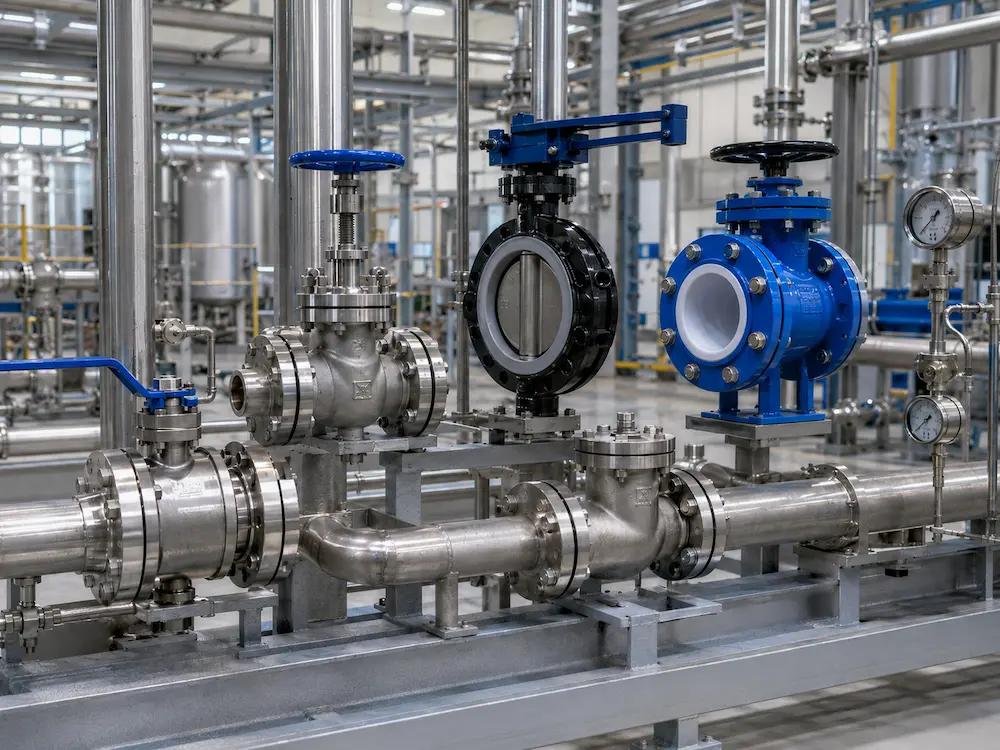
1. Chemical Industry Operating Conditions and Valve Challenges
1.1 The Challenge of Corrosive Media
Chemical processing involves a wide range of corrosive fluids, each with unique compatibility requirements. The key challenge is selecting materials that can withstand both chemical corrosion and mechanical stress simultaneously.
| Media Type | Corrosivity | Key Challenges | Common Temperatures |
|---|---|---|---|
| Sulphuric acid (H₂SO₄) | Strong acid, varies with concentration | Different concentrations/temperatures have vastly different corrosion behaviour | Ambient to 200°C |
| Hydrochloric acid (HCl) | Highly corrosive to most metals | Most metals (including stainless steel) are not resistant | ≤50°C typically |
| Nitric acid (HNO₃) | Strong oxidising acid | Only specific stainless steels are suitable | Ambient to high temp |
| Acetic acid (CH₃COOH) | Strongest organic acid | Requires Mo-containing stainless steel | Ambient to high temp |
| Alkalis (NaOH) | Corrosive, especially at high temp | Carbon steel can be used under moderate conditions | ≤100°C |
| Chlorides (Seawater, brine) | Chloride pitting, stress corrosion | 316L is recommended; higher alloys for severe service | Ambient to moderate |
1.2 Common Selection Mistake
A common misconception is that stainless steel is a "universal material" suitable for all corrosive media. This is incorrect and can be dangerous . For example:
304 and 316 stainless steels have limited resistance to sulphuric acid
Most stainless steels (including 316L) are not resistant to hydrochloric acid
Molybdenum-containing stainless steels may be less resistant to nitric acid than standard 304
2. Material Selection by Chemical Media
2.1 Sulphuric Acid (H₂SO₄)
Sulphuric acid is one of the most widely used industrial chemicals. Its corrosivity varies dramatically with concentration and temperature .
| Concentration/Temperature | Recommended Material | Notes |
|---|---|---|
| >80% concentration, <80°C | Carbon steel, cast iron | Good resistance—but not suitable for high-velocity flow |
| General service | High-silicon cast iron, high-alloy stainless steel (Alloy 20) | Alloy 20 is a nickel-chromium-molybdenum stainless steel with excellent H₂SO₄ resistance |
| Moderate service | PTFE-lined valves | Most cost-effective solution—PTFE is highly resistant to sulphuric acid |
| Not recommended | 304/316 stainless steel | Limited resistance to H₂SO₄ |
Selection guidance: For most sulphuric acid services, PTFE-lined valves offer the best combination of corrosion resistance and cost-effectiveness .
2.2 Hydrochloric Acid (HCl)
Hydrochloric acid is one of the most difficult media for metal valves. Most metallic materials (including stainless steels) are not resistant to hydrochloric acid .
| Concentration/Temperature | Recommended Material | Notes |
|---|---|---|
| General service | Rubber-lined valves, plastic valves (polypropylene, fluoroplastic) | Excellent corrosion resistance |
| Higher temperature/pressure | High-silicon iron (limited to ≤50°C, <30% concentration) | Limited applicability |
| Severe service | Special alloys (Hastelloy B) | High cost, only for severe conditions |
Key principle: For hydrochloric acid service, non-metallic materials (rubber-lined and plastic valves) are the preferred solution .
2.3 Nitric Acid (HNO₃)
Nitric acid is a strong oxidising acid. Stainless steel is the most widely used material .
| Temperature | Recommended Material | Notes |
|---|---|---|
| Ambient temperature, all concentrations | Stainless steel (304, 321) | Good resistance |
| High temperature | Titanium and titanium alloys | Specialised high-temp solution |
| Not recommended | Molybdenum-containing stainless steels (316, 316L) | May have less resistance than standard 304 |
Important: For nitric acid, 316L is NOT recommended—it can have poorer resistance than 304 in this specific service .
2.4 Acetic Acid
Acetic acid is the most corrosive of the organic acids .
| Temperature/Concentration | Recommended Material | Notes |
|---|---|---|
| General service | Stainless steel (304, 316) | Good resistance |
| High temperature / dilute acetic acid vapour | 316 stainless steel (Mo-containing) | Enhanced resistance |
| High temperature, high concentration, or with other corrosives | High-alloy stainless steel or PTFE-lined | More demanding conditions |
2.5 Alkalis (Sodium Hydroxide)
| Condition | Recommended Material | Notes |
|---|---|---|
| ≤80°C, ≤30% concentration | Carbon steel, cast iron | Economical choice |
| Higher temperature (100°C, <75%) | Carbon steel (increased corrosion, but economical) | Acceptable if iron contamination is allowed |
| High temperature | Titanium, titanium alloys, or high-alloy stainless steel | Severe service |
| General note | 304/316L | No significant advantage over carbon steel for alkalis—not recommended unless media purity requires it |
2.6 Chlorides (Seawater, Brine)
| Condition | Recommended Material | Notes |
|---|---|---|
| General seawater/brine | 316 stainless steel | Resists chloride pitting better than 304 |
| Severe chloride service | Duplex stainless steel (2205), special alloys | Superior resistance to pitting and stress corrosion cracking |
| Carbon steel | With coating protection | Suitable for mild chloride conditions |
Key warning: 304 stainless steel is susceptible to pitting in chloride environments—use 316L or higher .
3. Special Alloys for Severe Chemical Service
3.1 Overview of Special Alloys
For extremely corrosive conditions, special alloys provide superior resistance at higher cost .
| Alloy | Key Properties | Best Applications |
|---|---|---|
| Duplex stainless steel (2205) | High strength, excellent chloride resistance | Chloride environments, seawater, sour gas |
| Monel (Ni-Cu) | Excellent seawater and acid resistance | Marine, hydrofluoric acid, seawater |
| Inconel (Ni-Cr) | High-temperature strength, oxidation resistance | High-temperature, corrosive service |
| Hastelloy C-276 | Universal corrosion resistance | Severe acid service, chlorides |
| Alloy 20 | Excellent sulphuric acid resistance | Sulphuric acid, phosphoric acid |
| Titanium | Excellent nitric acid, chloride resistance | Nitric acid, high-temperature chlorides |
3.2 Material Performance Comparison
| Material | H₂SO₄ | HCl | HNO₃ | Acetic Acid | Chlorides | Temperature Capability |
|---|---|---|---|---|---|---|
| Carbon steel | Good (concentrated) | Poor | Poor | Poor | Fair | ≤425°C |
| 304 SS | Poor | Poor | Excellent | Good | Poor | ≤800°C |
| 316L SS | Poor | Poor | Limited | Excellent | Good | ≤800°C |
| Alloy 20 | Excellent | Fair | Good | Excellent | Good | ≤425°C |
| Hastelloy C-276 | Excellent | Good | Excellent | Excellent | Excellent | ≤540°C |
| Duplex 2205 | Good | Poor | Good | Good | Excellent | ≤315°C |
| PTFE-lined | Excellent | Excellent | Excellent | Excellent | Excellent | ≤232°C |
4. Valve Type Selection for Chemical Applications
4.1 Recommended Valve Types by Service
| Service | Recommended Valve Type | Reason |
|---|---|---|
| Isolation (clean corrosives) | Ball valve (PTFE-seated) or Plug valve | Quick operation, reliable sealing, PTFE compatibility |
| Isolation (dirty/particulate corrosives) | Diaphragm valve or Knife gate valve | Clog resistance, corrosion-resistant linings available |
| Precise control | Globe valve (PTFE-lined) or Control valve | Throttling capability, corrosion-resistant trim |
| Large-diameter isolation | Butterfly valve (PTFE-lined) | Cost-effective, suitable for large sizes |
| Sanitary/corrosive service | Sanitary diaphragm valve or Sanitary ball valve | Dead-leg-free, cleanable |
4.2 Lining and Coating Options
| Lining/Coating | Temperature Limit | Best Applications |
|---|---|---|
| PTFE (F4/F46) lining | ≤232°C | Most acids, alkalis, solvents |
| PFA lining | ≤260°C | Higher temperature, similar chemistry |
| Rubber lining | ≤100°C | Hydrochloric acid, water treatment |
| Glass lining | ≤250°C | Acid service (but fragile) |
| Epoxy coating | ≤150°C | General corrosion protection |
5. Sanitary Valves in Chemical Applications
In specialty chemical, fine chemical, and pharmaceutical intermediate manufacturing, Sanitary Ball Valve and Sanitary Butterfly Valve products find increasing application due to their corrosion-resistant materials and cleanability:
| Application | Recommended Valve | Key Requirement |
|---|---|---|
| Corrosive media handling | Sanitary ball valve (PTFE/TFM seats) | Chemical compatibility, zero dead leg |
| High-purity chemical transfer | Sanitary butterfly valve (316L, electropolished) | Low contamination, CIP compatibility |
| Specialty chemical dosing | Sanitary diaphragm valve | Corrosion resistance, precise control |
The full-bore design, 316L stainless steel construction, and CIP/SIP compatibility that make Sanitary Ball Valve products ideal for food and pharma are equally valued in chemical applications where product purity and cleanability are critical .
6. Summary: Chemical Valve Material Selection Flowchart
Step 1: Identify the chemical and its concentration/temperature
    │
    ▼
Step 2: Determine if non-metallic (PTFE-lined) is acceptable
    ├── Yes → Select PTFE-lined valve (cost-effective, universal resistance)
    └── No → Proceed to metallic material selection
    │
    ▼
Step 3: Select based on specific chemical
    ├── Sulphuric acid → Alloy 20 or PTFE-lined
    ├── Hydrochloric acid → PTFE-lined or rubber-lined (non-metallic preferred)
    ├── Nitric acid → 304 SS (NOT 316L)
    ├── Acetic acid → 316L SS
    ├── Alkalis → Carbon steel (if iron allowed) or titanium (high temp)
    └── Chlorides → 316L SS or duplex stainless steel
    │
    ▼
Step 4: Consider temperature and pressure
    │
    ▼
Step 5: Select valve type based on function (isolation/control)
    │
    ▼
Step 6: Verify with manufacturer material compatibility data
7. Series Navigation
← Previous article: Valve in Water Treatment Applications: Large-Diameter Isolation and Chemical Dosing Systems
→ Next article: Valve Installation Standards and Maintenance Strategies (General Summary)


