


Sanitary Fittings Selection and Usage: The Complete Guide
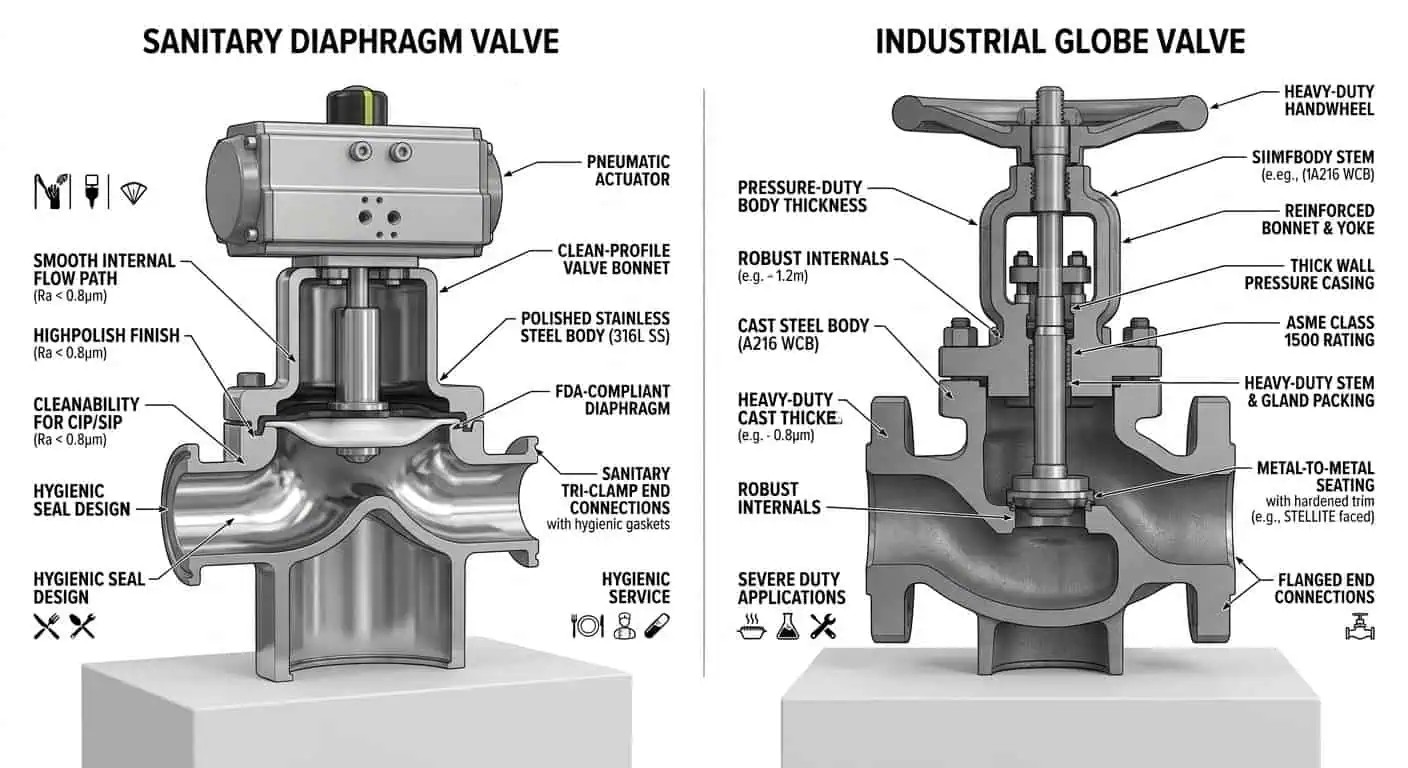
In the food, beverage, pharmaceutical, biotech, and cosmetic industries, sanitary fittings are fundamental components that ensure product purity, system safety, and regulatory compliance. Unlike standard industrial fittings, sanitary fittings are specifically designed to meet stringent hygiene standards—featuring smooth internal surfaces, crevice-free construction, and corrosion-resistant materials that make them indispensable in high-purity fluid handling systems.
This guide provides a systematic overview of sanitary fitting types, materials, connection methods, selection criteria, and certification standards, offering a complete reference framework for engineering, procurement, and O&M personnel.
1. What Are Sanitary Fittings?
Sanitary fittings are components used to connect pipelines into complete fluid handling systems, manufactured from stainless steel for applications in pharmaceutical, food, beverage, and other industries requiring high hygiene standards.
Core characteristics of sanitary fittings:
| Characteristic | Description |
|---|---|
| Material | Primarily 304 or 316L stainless steel—corrosion-resistant, easy to clean |
| Surface finish | Internal surface Ra ≤ 0.8μm (standard sanitary), Ra ≤ 0.4μm (aseptic) |
| Construction | Crevice-free, dead-leg-free—eliminates microbial hiding places |
| Certification | Complies with 3-A, FDA, EHEDG, ASME BPE standards |
| Cleanability | Supports CIP (Clean-in-Place) and SIP (Sterilisation-in-Place) |
The key distinction between sanitary fittings and standard industrial fittings is that cleanability is the primary design objective—all internal surfaces must be smooth, crevice-free, and fully drainable.
2. Main Types of Sanitary Fittings
Sanitary fittings come in a wide variety, classified by function into the following categories:
2.1 By Connection Type
| Type | Characteristics | Applications |
|---|---|---|
| Tri-Clamp fittings | Quick assembly/disassembly, tool-free; the most common sanitary connection method | Pipelines requiring frequent CIP/SIP cleaning |
| Weld fittings | Permanent connection, zero leakage, highest hygienic integrity | High-purity systems, WFI pipelines, permanent installations |
| Threaded fittings | Simple installation, low cost | Auxiliary lines, low-pressure systems |
| Flanged fittings | High pressure rating, removable | Large-diameter, high-pressure systems |
Tri-Clamp connection (also known as Tri-Clamp or Tri-Clover) is the most mainstream sanitary connection method. Its structure consists of three parts: ferrules (with sealing grooves), gaskets, and clamps. The clamp's tightening force creates a seal between the gasket and the two ferrule faces.
2.2 By Function
| Type | Function | Typical Application |
|---|---|---|
| Elbow | Changes pipeline direction (45°, 90°, etc.) | Pipeline turns and bends |
| Tee | Three-way connection, divides or combines flow | Branch pipelines |
| Cross | Four-way connection | Complex pipeline layouts |
| Reducer | Connects different pipe diameters | Pipe size transitions |
| Adapter | Connects different types or standards of fittings | System compatibility |
| Clamp | Secures ferrules and gaskets | All Tri-Clamp connections |
| Gasket | Sealing | All Tri-Clamp connections |
| Cap/Plug | Closes pipeline ends | Pipe terminals, spare ports |
| Union | Removable connection | Locations requiring frequent disassembly |
3. Material Selection
3.1 Stainless Steel Material Comparison
| Material | Characteristics | Applications |
|---|---|---|
| 304 Stainless Steel | Good corrosion resistance, lower cost | General food, beverage, water treatment |
| 316L Stainless Steel | Contains molybdenum (Mo), superior chloride and acid/alkali resistance | Pharmaceutical, biotech, chlorine-containing CIP, aggressive corrosive media |
316L is the preferred material for sanitary applications. The "L" designation indicates low carbon content (≤0.03%), which prevents intergranular corrosion during welding, ensuring long-term corrosion resistance.
3.2 Seal Material (Gasket) Selection
Gaskets are critical components of sanitary fitting sealing systems. Material selection directly affects sealing performance and media compatibility:
| Material | Temperature Range | Suitable Media | Not Suitable For |
|---|---|---|---|
| EPDM | -40°C ~ +150°C | Water, steam, alkaline CIP, food | Oils, hydrocarbon solvents |
| Silicone | -60°C ~ +200°C | Food, high-purity media, low-temperature | Steam, strong acids, oils |
| PTFE | -200°C ~ +260°C | Strong acids, strong alkalis, organic solvents | Strong alkalis at high temperatures (creep) |
| FKM (Viton) | -23°C ~ +150°C | Oils, organic solvents, high-temperature | Amines, ketones, live steam |
Selection tip: For processes involving CIP/SIP cycles, EPDM and PTFE are the most common choices. For oil-containing media, choose FKM or PTFE.
3.3 Surface Finish
Surface finish is a core quality indicator for sanitary fittings:
| Grade | Ra Value | Applications |
|---|---|---|
| Standard sanitary | ≤ 0.8μm | General food, beverage, dairy |
| High sanitary | ≤ 0.5μm | Premium food, cosmetics |
| Aseptic | ≤ 0.4μm (electropolished) | Pharmaceutical, biotech, WFI |
4. Key Certifications for Sanitary Fittings
Different industries and markets require different certifications. Confirm that fittings meet applicable standards during selection:
| Certification/Standard | Applicable Scope | Core Requirements |
|---|---|---|
| 3-A Sanitary Standards | US dairy, food, pharmaceutical | Hygienic design, cleanability |
| FDA 21 CFR | Food and drug contact materials | Material safety, composition compliance |
| EHEDG | European food, pharmaceutical | Hygienic engineering design certification |
| ASME BPE | Biopharmaceutical | Surface finish, traceability, welding |
| ISO 2037 / DIN 11850 | International/European fitting dimension standards | Dimensional specifications |
| USP Class VI | Pharmaceutical, biotech | Biocompatibility testing |
5. Key Selection Criteria
5.1 Four-Step Selection Process
Step 1: Define application scenario and process requirements
Media characteristics: Food, pharmaceutical, cosmetic, or chemical? Contains corrosive components?
Temperature and pressure: Maximum operating temperature and pressure?
Cleaning requirements: CIP/SIP required? Cleaning frequency?
Step 2: Confirm compliance standards
Determine required certifications based on target market and industry (3-A, FDA, EHEDG, etc.)
Require suppliers to provide certification documents and Material Test Reports (MTRs)
Step 3: Select material and surface finish
Prefer 316L stainless steel (pharmaceutical, corrosive media) or 304 stainless steel (general food)
Determine surface finish grade based on cleaning requirements
Step 4: Determine connection type
Frequent disassembly for cleaning required → Tri-Clamp
Permanent high-purity systems → Welded
Auxiliary lines or low-pressure systems → Threaded
5.2 Common Selection Mistakes
| Mistake | Correct Practice |
|---|---|
| Selecting solely on price | Prioritise material, certification, and traceability |
| Ignoring surface finish requirements | Specify Ra value, request test reports |
| Using mismatched gasket materials | Select gasket based on media and temperature |
| Ignoring certification requirements | Confirm applicable 3-A, FDA, EHEDG certifications |
6. Installation and Maintenance Recommendations
6.1 Tri-Clamp Connection Installation Tips
Install gasket correctly: Ensure the gasket is fully seated between the two ferrule faces
Tighten clamp evenly: Hand-tighten is sufficient—over-tightening can damage flanges and gaskets, while under-tightening may cause leakage or gaps
Regular inspection: Check flanges, gaskets, and clamps for wear, corrosion, or damage
6.2 Welded Connection Tips
Inert gas shielding (argon) must be used during welding to prevent internal surface oxidation
Weld internal surfaces should be smooth, crevice-free, and flush with the pipe wall
Borescope inspection should be performed after welding to verify weld quality
6.3 CIP/SIP Compatibility
Sanitary fittings should be designed to support CIP and SIP processes. Smooth internal bores and crevice-free construction ensure effective cleaning and sterilisation without disassembly.
7. Summary and Action Recommendations
Sanitary fittings are fundamental components ensuring product safety and compliant operation in food, pharmaceutical, and biotech industries. Selection should focus on:
Material: 316L stainless steel is the standard choice for sanitary applications
Surface finish: Ra ≤ 0.8μm; aseptic processes require Ra ≤ 0.4μm
Certifications: Confirm applicable 3-A, FDA, EHEDG standards
Connection type: Tri-Clamp is the most versatile and convenient choice
Gasket material: Select EPDM, PTFE, silicone, or FKM based on media and temperature


